As I mentioned in my “reviews” of the Lesserton and Mor product, Strathbogie did recover his spell book, with interest, and justice, perhaps excessive, was done to the elf who had stolen it. It was a great game, with each of the PCs making an interesting contribution. Strathbogie bought some decent clothes and took a meal at the Platinum Pegasus, the one really fancy place to eat in town. Sure enough, there was an elf staying there. Strathbogie tailed him out, and watched him buy a horse. And he got a good enough look at him to be sure that this was the same elf who’d sold his spell book to the Platonic Order. But as I mentioned in my review, Lesserton is not the kind of place where you can expect much from the authorities. We didn’t consider reporting the theft and even after we knew who the thief was, we knew we’d have to deliver justice on our own. But outright lawlessness is not tolerated inside the city walls. His purchase of a horse told us he was planning to leave soon. So Thakko talked to his friend Hank who owns the stables at the city gate. The elf’s horse was there. Hank had a sense of when the elf was planning to leave town, and he agreed to add something to the horse’s feed so that it had some problems out on the road. Meanwhile, we prepared an ambush. Thakko and Isdn found a place to hide about an hour outside town. Isdn buried bug teeth in the road to serve as caltrops. Strathbogie hung around outside the gate.
Briefly, the plan worked. Not perfectly, but well enough. The elf wasted his charm spell on Strathbogie who would have been nearly useless in combat anyway. Thakko and Isdn were not especially well-hidden but the bug teeth were. We felt a little sorry for the elf’s hired guard who got mixed up in all this. But that's swamp justice for you.
Wednesday, March 23, 2011
Lesserton Play Report: Swamp Justice

Thursday, March 17, 2011
Review : Lesserton and Mor II (One Player’s Perspective on Mor)

Perhaps the best testament to the interest of Lesserton is the fact that our party has spent little game time in Mor. There’s enough going on in town that we’ve only ventured out on a few narrowly-defined missions. It’s also because while Mor itself probably contains dungeons, we haven’t been looking find them, and have experienced Mor as a “wilderness.” In some ways, Mor is not so different from Lesserton—some of our most interesting encounters have been with the Orkin tribes, who are of the type that put the “human” back into humanoid. We have not fought any of them (although there are rumors of more warlike tribes who might attack on sight) and have instead engaged them in trade.
Whether Mor is a “dungeon” or a “wilderness,” it is an expansive ruins and this type of setting is popular for good reason. The mirror image of the dirty little town of Lesserton, the ruined capital of Mor juxtaposes the grander of towers, temples, palaces, and fountains with weedy swamps and lots of beasties. Although the Mor Book includes a “dungeon crawl,” I expect that our adventures have been generated by random tables supported by concise descriptions of notable locations.
A glance at the Mor map shows that much of Mor is left for the referee to fill in. It seems that there is enough background description and random tables for the referee to run a few sessions as a way of introducing the setting and gauging player interest. I think my group has reached the point where we’re hoping for something meatier. Again, leafing through the Mor book, I don’t know that there’s anything ready-made. But as a player, I am curious about all those supposedly empty building, and I know that we haven’t even seen more than a small portion of the ruins. There’s a lot of “emptiness,” but the it doesn’t feel empty; I’m engaged enough to believe that there’s a lot more to discover.
What makes Mor most engaging are the constant subtle reminders of its connections to Lesserton. These connections are probably most evident in Lesserton. Many of the townsfolk will speak openly of their distrust or dislike of elves, and their “reason” (something about the elves failure to prevent the destruction of Mor) is so well-know that it doesn’t need to be said. Likewise, anyone who shows strong Orkin traits is regarded, with a mixture of fear and condescension, as being “from the ruins.” Then, when you’re in the ruins, those residents (the Orkin tribes) speak of Lesserton with their own mixture of wonder and disdain.
I should state directly, if it’s not obvious, that I’ve been playing D&D a long time and so have the other players. Less experienced players might have some frustrations with the PC's poverty, the slow level advancement, and the lack of signs saying, “This way to the Dungeon.” These issues could be “corrected.” For instance, there are a couple adventures included, including a mini-dungeon set in Mor. A referee could get this one going in the typical way (“you’re hanging out in the tavern and a stranger comes up to your table.”) To be successful, the referee might have to allow more standard character collection, so that thief characters could not only afford lockpicks but also know where to buy them. Some value would be lost—the way we got to know Lesserton was by, for instance, checking in at various potential purveyors of lockpicks. And likewise, when we entered Mor, we knew that we couldn’t survive more than one or two fights and were thus forced to negotiate with the Orkin. But maybe there are other ways to balance competing values.
In summary, I’ve very much enjoyed playing in both Lesserton & Mor, and having a hard time restraining myself from delving into the “DM-only” books more deeply so that I might start planning a session with my own group of players.
Tuesday, March 8, 2011
Review : Lesserton & Mor I (One Player’s Perspective on Lesserton)

Wednesday, February 23, 2011
Lesserton Pub Crawl

Lesserton's much seedier than is represented in the picture at right, but that's kind of the idea.
Strothbogie and Brigitta have lost their spell books. They were stolen. Strothbogie has a couple contacts with some possible leads. First, another young magician, an associate at the Platonic Order says he heard that someone, an elf, had come by trying to sell two books to the order, and had sold one for 300 gold pieces. And his friend Rusty at the Vanhalla, who had helped him in the past, promised to be on the lookout for the books. Come to think of it, he didn’t really have much information, but just questions. How much would a book like that be worth? Those things aren’t like cursed are they?
I don’t know if Strothbogie will find his books, but he enjoyed having money to spend looking for them.
Thursday, February 10, 2011
look again
For example, in the more recent Lesserton & Mor game, the party met a new PC named Isden. Because we met each other inside the ruins of Mor, it was a little awkward at first, with Isdn trying to hide in the shadows and Strothbogie poking him with a stick to see if he was real. So when the rats attacked, the rest of the party took refuge in the illusionary fire, and Isden fended for himself.
According to the referee, Isden was in a “ruined building.” Isden looked more closely and suggested that : (1) the roof might be intact (2) that there were holes in the roof that would allow access to someone inside and (3) that there would be some wooden support beams that he could use to climb up. I don’t know whether the referee rolled some dice or had to think about how these three ideas meshed with his own impressions of the setting. But it worked out ok for Isden and he got away from the rats. His player didn’t really create or change the setting, he just suggested details that seemed to fit with what he already knew.
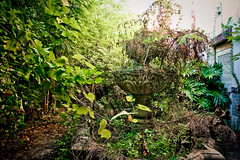
Later, we returned to the task of cleaning the sacred fountain. The problem wasn’t stirges anymore; it was the plants growing in it that tried to strangle people. And again, we looked more closely at those ruined buildings. Was there a beam that could be removed safely, set on fire, and be thrust into the tangle of weeds? Yes. It didn’t work exactly according to our plan, but again players and referee collaborated over details that wouldn’t have seemed important to the referee while working alone.
On the road to Quitokai
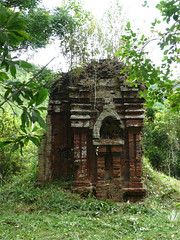
The party traveled several days through the forest. Sometimes monotonous, the journey was generally peaceful. They happened upon a deserted guardhouse and found a cache of weapons. And they hunted monkeys to supplement their rice cakes and steamed scorpion.
Early one morning, Gwinch noticed that Kishi had left her backpack open and that there was a scroll sticking out of it. It wasn't a magic scroll, but a message. Although the full meanng was ambiguos, the words "assasinate" and "Gwinch" in the same sentance gave him some alarm. Kishi ran away, and the rest of the party traveled without her.
After a couple days, they left the forest behind and traveled through burnt grains fields and ruined rice paddies. In a stand of bamboo, they were ambushed by villagers. One member of the party, Deng, was local the areas, and negotiated a truce. The villagers were suspicious and warned the party to not press any further but wait for word from the elders.
When the elders arrived, accompanied by 50 armed villagers, they questioned the party. What are you doing here? Gwinch explained that he had discovered renegade members of his monastery were conducting a slaving operation and that he had come to put a stop to it. The villagers had indeed experienced this problem first-hand. It seemed that both monks and former soldiers were part of the operation. When the party learned that the slavers had a hideout in the mountains somewhere between the forest and the burned grain fields, they agreed that they would investigate. The elders allowed one of their warriors a woman named Orya to go with them. And they took the wounded sohei back to their village so they could recover and be their hostage.
Although the party had a crude map, they had some difficulty in find the way to the slavers' hideout. in their exploration, along a stretch of the remains of an ancient highway, they met a small group of soldiers, claiming they were there to arrest Gwinch. Inevitably, the soldiers or brignads were killed. The party found the path that they believed led to the hideout, but decided to go Quitokai (Orya's village) to rest and plan before making their sortie. Their fight with the soldiers was taken as partial proof of their sincerity and the party was allowed to stay in the village.
Tuesday, February 1, 2011
mission from the emperor
Gwinch accepted. He made some attempts to do some last-minute investigation, but didn't get a good opportunity to discover anything substantive.
Kish provided little in the way of details. There was a problem in one of the Southern Provinces. First with savages, then with the Governor, then with a General sent to help to Governor. The Khan wanted the party to track down both the General and the Governor, both of whom are considered likely traitors.
Over a month, the party traveled with the army to the southwest corner of the empire, fidning increasing surly peasant along the way. As they approached the border, large parts of the army deserted, and at the border, the army's commander left the part on their own, telling them only to head south and try to pick up the trails of Kawabi and Goyat in the Kumandang Valley.
The party spent a day traveling in the forest, at first enjoying the change from being part of a large army and passing through broken farmland populated by angry farmers. That night they were attacked by a giant scorpion. Relying on the spells of Kishi and Saisho, cooked it nicely and had a nice feast.