We made our way across the weed- and rubble-choked moat into Mor, and followed the remnants of the old wall to a ruined tower. From there, we headed south, following the traces of what was once a great avenue leading to the palace. The fountain that I (Strothbogie) had promised to cleanse was overgrown with so many pointy- and twisty- vines and weedes and with them those pointy- and twisty- birds that feast on the blood of men called STIRGES.
Three of them hunted us and we killed them. But not wanting to confront the entire flock, we withdrew, hoping to make the acquaintance of other good folk eager to join us in combat against a common enemy or, failing, that, a fat goat for the STIRGES to drain in our stead.
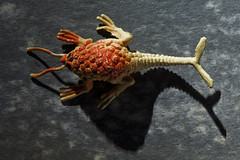
We encounter neither goat nor human friend, but a specimem of those creatures seemingly born in the minds of lunatics and those cunning merchants eager to supply such lunatics with a parade of implausible realities, this one shaped like a tortoise but with legs like a hairless dog, horrible long-toed feet, a forked tail, two equisitely feathry and tickly antennae, and a constant appetite for metal-- to whit-- a RUST MONSTER. Realizing that despite its fearsome appearence, the beast bore no significant threat to those who do not encapsulate themselves in steel, we negotiated-- in the crude way the beast could understand-- to whit-- the clanking of coins and daggers-- that should the RUST MONSTER follow us to the nest of the STIRGES, it might enjoy those same coins and daggers that so enticed it with their clanking.
The RUST MONSTER drew off a number of the STIRGES, and we-- to whit Strothbogie, Thakko, Briggitta, and Robo-- killed the remainder.
And this is how, I, Strothbogie, was able to taste for the first time the sacred water of that holy fountain.
Tuesday, January 25, 2011


Sunday, January 16, 2011
Lamentations! (The Teeth of the Dark)
Although I've been curious to have a look at Death Forst Doom and Jim Raggi's various other adventure modules, I didn't really see the point of releasing your own version of "the game." Of course anyone who deliberates for more than a year over a $5 purchase is probably not part of anyone's target market, and my reasons are unfairly contradictory, but here they are, supported by my recent experience in playing in a "LotFP" game.
My first point, is the doing "weird fantasy" is a worthwhile goal, but it's not supported by new rules. I think it's best supported by adventures (and Raggi's adventures have been very well-received) or you do it by playing the game with people who have all read Lovecraft or whoever and agree that's the kind of flavor you're all going for. Or a little of both or a lot of both. Yesterday's game might be called a little of both and in fact that made for a great game. The referee had the LotFP pdfs and had created his own adventure. Speaking for myself, I had a vague understanding of what "weird fantasy" means and I was ready to participate. The other players knew at least as much as me.
Our characters were caravan guards and our patrons had chosen a bad route, and gotten us lost, so we stopped in a little village to ask for directions. It was a decidely creepy village, but most of the caravan members wanted to sleep in a warm bed rather than in the open. We were attacked at the inn, captured one of our attackers, and learned that the villagers were all part of an evil cult that met in a cave outside town, led by the obviously creepy mayor. We went out to the cave, killed the leader and most of the cultists and got killed ourselves. And again, it was great-- it's a nice variation on the usual low-level adventure theme that the little village in need of your help wants to throw you into a fissure. And that even though you know you shouldn't be there at all, for some reason you feel compelled to stay. But I don't think Raggi's rules had much to do with it. There are some nice innovations, some of them borrowed from recent editin. Ascending armor class makes a lot of sense-- you should just have to roll higher than the AC on a d20! Obvious but ingenious. His encumbrance rules are great, too. Most items, other than metal weapons or big weapons "count" more or less the same, and every 6 items you move to the next lowest encumbrance class. I'd like to start using encumbrance and this would be a good way to do it. Magic-users can use swords-- they're just not that great at it. This is a really nice improvement-- no more master of the dagger. And no more guessing someone's character class by checking out what weapons and armor they have. But none of this really contributes to weird fantasy flavor. They're just nice and relatively minor innovations on the rules. (And maybe part of what's nice is exactly that they are minor.)
My other point is kind of unfair: even if you can re-create the ruleset to encourage weird fantasy, you shouldn't. In these rules, both Elves and Magic-Users are Chaotic. This changes and complicates usual understandings of all three of these entities. Elves and Magic-Users are more decidedly weird. And Chaotic is not such a simple short-hand for evil. The magic-user and elf definitely had fun with this and it added something to our game. But adding new *permanent* limitations doesn't add to "the game." Because what I most appreciate about D&D is its versatility. A campaign where magic-users are required to be chaotic is cool. But so is a campaign where Magic-Users are required to be lawful because magic is powered by increasingly inflexible adherence to a higher order. What's the point of hard-coding such innovations into the game rules? Choosing one option always requires foreclosing others, but rather than do this at the "game system" level, let's do it at the campaign, setting, or adventure level.
My first point, is the doing "weird fantasy" is a worthwhile goal, but it's not supported by new rules. I think it's best supported by adventures (and Raggi's adventures have been very well-received) or you do it by playing the game with people who have all read Lovecraft or whoever and agree that's the kind of flavor you're all going for. Or a little of both or a lot of both. Yesterday's game might be called a little of both and in fact that made for a great game. The referee had the LotFP pdfs and had created his own adventure. Speaking for myself, I had a vague understanding of what "weird fantasy" means and I was ready to participate. The other players knew at least as much as me.

Our characters were caravan guards and our patrons had chosen a bad route, and gotten us lost, so we stopped in a little village to ask for directions. It was a decidely creepy village, but most of the caravan members wanted to sleep in a warm bed rather than in the open. We were attacked at the inn, captured one of our attackers, and learned that the villagers were all part of an evil cult that met in a cave outside town, led by the obviously creepy mayor. We went out to the cave, killed the leader and most of the cultists and got killed ourselves. And again, it was great-- it's a nice variation on the usual low-level adventure theme that the little village in need of your help wants to throw you into a fissure. And that even though you know you shouldn't be there at all, for some reason you feel compelled to stay. But I don't think Raggi's rules had much to do with it. There are some nice innovations, some of them borrowed from recent editin. Ascending armor class makes a lot of sense-- you should just have to roll higher than the AC on a d20! Obvious but ingenious. His encumbrance rules are great, too. Most items, other than metal weapons or big weapons "count" more or less the same, and every 6 items you move to the next lowest encumbrance class. I'd like to start using encumbrance and this would be a good way to do it. Magic-users can use swords-- they're just not that great at it. This is a really nice improvement-- no more master of the dagger. And no more guessing someone's character class by checking out what weapons and armor they have. But none of this really contributes to weird fantasy flavor. They're just nice and relatively minor innovations on the rules. (And maybe part of what's nice is exactly that they are minor.)
My other point is kind of unfair: even if you can re-create the ruleset to encourage weird fantasy, you shouldn't. In these rules, both Elves and Magic-Users are Chaotic. This changes and complicates usual understandings of all three of these entities. Elves and Magic-Users are more decidedly weird. And Chaotic is not such a simple short-hand for evil. The magic-user and elf definitely had fun with this and it added something to our game. But adding new *permanent* limitations doesn't add to "the game." Because what I most appreciate about D&D is its versatility. A campaign where magic-users are required to be chaotic is cool. But so is a campaign where Magic-Users are required to be lawful because magic is powered by increasingly inflexible adherence to a higher order. What's the point of hard-coding such innovations into the game rules? Choosing one option always requires foreclosing others, but rather than do this at the "game system" level, let's do it at the campaign, setting, or adventure level.
Tuesday, January 11, 2011
Less, More, and versatility of D&D
Not only did we find a buyer in the town of Lesserton for the honey, but we earned a nice sum of money and invested all of it a little barrel of lamp oil, which the Orkin tribes of Mor call “firestarter.” And pay very well for. We returned to the beekeepers in the ruins of Mor and traded the barrel for a couple fat wineskins, plus a few doses for Strothbogie to consume. The keepers gave us a word, “snickers” and insinuated that they were most used to dealing with a different, larger, meaner group of honey-traders.
And so, when we returned to Mor, we had to be cautious about how we sold it. With all of our wealth more viscous than liquid, we slept a couple nights in a barn and ate trail rations before Strothbogie’s friend Rusty could find us a wholesale buyer. Strothbogie’s hankering for the stuff further complicated our efforts—he continued to take the odd dose once a day or so, even relying on magic to deceive his associates. And he bungled the sale, selling off the entire stock, rather than saving a portion to use in brewing or baking.
But this mistake might have saved his life. When he went into withdrawal, there was no honey left for him to consume, and so Brigitta took him to the Temple of the Divine Purpose. His friends worked out a deal with the Priests—heal our friend and we’ll perform a quest for you. Strothbogie rather enjoyed the ritual of purification and is eager to return to Mor in search of the fountain of holy water, hoping to repeat the experience.
Playing in this campaign confirms my opinions about D&D’s versatility. The atmosphere is rather different from that of the standard D&D setting. But these differences are supported by only the slightest tweaks to the rules. The same classes are there and they work in the same familiar way. One of the members of the party, Thakko, is an Orkin, which explains his long pointed ears and low charisma, but his special abilities are of the sort normally granted to demi-humans. Starting the game with very little money is a great innovation—one that I’ve experimented with a little in the past and now embrace whole-heartedly. It makes finding, for instance, a cache of normal weapons really exciting. What I like best is how this might develop in the future. If the players/characters get tired of their current post-apocalyptic setting, there’s no need to switch to a different game or even a different campaign. There’s a road leading south that I can only guess leads to somewhere like Greyhawke or the Grand Duchy of Karmeikos. The fact that we’d be arriving in those places with “baggage” from Lesserton and Mor only adds to the interest.
Saturday, January 8, 2011
Play Report: Gwinch kills Sheevani
Gwinch had planned to go to the House of Jourdain for the "special event," but he had not recovered from his wounds and hoped to find a healer before venturing into another potentially dangerous situation. He had once before explored the House of Jourdain a pair of "foreign barbarians" Myrrha, a priestess, and Cair, a seeming jack-of-all-trades and decided to seek them out at their palatial minimum-security prison inside the Forbidden City. Not only might Myrrha heal him, but if he could help them slip out of the Forbidden City for the night, they might accompany him on his planned outing.
This plan, was subject to detour. H couldn't remember which house they lived in, and following one lead and another, got the opportunity to meet a different, local, priest (who by chance had been part of Beatriss's first expedition to the House of Jourdain.) The priest, Afu, asked Gwinch some questions about what he'd learned in Zhou Dang, specifically "what he'd learned of good and what he'd learned of evil." Somewhat impatiently, Afu asked Gwinch about his boots, "Those are very unsual boots, where did you get them?"
Gwinch candidly expalined that he'd been attacked by a man wearing them, killed his assailant, and appropriated the boots.
Somewhat predictably, Afu revealed that he thought he knew the man. This prompted a discussion of what exactly the Two-Fold Path was doing in Khanbali-- at the Temple, at Gwinch's Mediation Hall-- and what did Gwinch think about it.
Gwinch confessed his on-going confusion. Of course there seemed something seedy about it, but it seemed like the women were enjoying themselves. Afu suggested that Gwinch would do well the follow the example of his dead friends, and try to look beneath the surface. As a condition of "forgiving" Gwinch, he asked him to take an oath, that he would investigate more particularly what was going on. And then Afu blessed and healed him.
Gwinch did find Myrrha and Cair, and he told them about his meeting with Afu. Soon, they had agreed that they would make a visit to Gwinch's old place, and rob Sheevani. Not only was there a better balance of risk and reward, but this would more directly satisfy Gwinch's oath.
Gwinch's reconnaisance of a few nights before paid off beautifully. They entered, silently and invisibly, and quickly found there way into Sheevani's room. They found a locked box and took it into their possession. They killed Sheevani, and the three samurai guards, and then fled into the night, arriving at the ruined monastery near dawn.
The box contained a large sum of money, and some interesting documents. While it would take some time to decipher them thoroughly, they seemed to provide details about how people from the rural and mountainous border regions were brought to Khanbaliq and then sold as slaves-- prostitution, forced labor, doemstic service, etc. It suggested that not only were there dungeons in the Temple outside the city, but also a larger compund somewhere in the mountains to the south.
Cair propsed that with the money, they might secure a ship and leave Zhou Dang once and for all, but Gwinch replied that he saw enough reasons to linger a little longer.
He invested his share of the money in more provisions, weapons and armor for his men as well as some furnishings for their hideout.

Tuesday, January 4, 2011
outlaw Gwinch

Gwinch’s exile gave him an opportunity to reflect on his activities over the when year. Saisho was there to be his mirror.
G: “When you first described the House of the Lucky Dragon, I condemned that kind of business.”
S: “And then later, you started one yourself.”
G: “That wasn’t what I intended.”
S: “No.”
G: “But the women seemed like they liked it.”
S: “They did.”
After laying low in the forest for a couple weeks, Gwinch led his men to the ruined monastery a couple hours outside Khanbaliq.
Gwinch had learned that the ruined monastery was used as a base for local monks on their way back from trips to the hinterlands in search of “temple servants.” Following (or misinterpreting) the wu jen’s dying admonition that they should look “under the temple” to see what was really going on, Gwinch and his men thoroughly explored the rubble of the ruined monastery and did indeed find a buried set of stairs. Clearing a path, they found a door, and opened it, and lit some torched to explore a musty, but innocuous complex of about a dozen rooms, once used for storage or as emergency hiding places. They also found a barred door. They opened it, followed danker, rougher passage deeper underground until they reached a small stream arched by a stone bridge. Crossing the bridge proved hazardous and although no one was fatally injured, Gwinch himself received enough wounds that he led his men back to the safe part of the monastery and barred the door. He and Saisho went to Khanbaliq, hoping to find recruit fellow dungeon-delvers.

But first he decided to do a little reconnaissance at his old house. He and Saisho, relying on spells and magic items, silently and invisibly climbed the wall, and from the roof of one the outbuildings, watched the goings-on. The stake-out was somewhat tedious for both Gwinch and bubu Singe but a few interesting pieces of information emerged:
Sheevani and the women were still there. A good number of young samurai and Zipangese clerks were now living in the compound. At the end of the night, when the light went off in the banquet room, no one left the compound. Most people went to sleep, and one samurai guard stationed himself just outside each of the three entrances to the women’s sleeping quarters. Gwinch tried a couple ruses to get into the building, and when these failed, they went to explore other parts of the city.
He met a small gang of men running a game of chance and profit just inside the walls of the outer city. Their leader wasn’t interested in doing that kind of thing, but he knew people. And he remembered Gwinch from the martial arts tournament and seemed eager to ingratiate himself, suggesting that he could help Gwinch get into some prize fights. Gwinch declined, but they agreed that Gwinch would show up at an event that was being hosted at the House of Jourdain in a few days time, featuring some high stakes gambling and plenty of women to cheer on the winners. And for Gwinch, a chance to meet some useful contacts.
Sunday, December 26, 2010
Delivering Beatriss / Exiling Gwinch
Gwinch returned to the forest with Iriyo, both of them accompanied by a wu jen and other assistants. Wutambi (the "other" wu jen) located the fox spirit and began attacking it with his magic, and Iriyo attacked first with his sword and then with his bare hands, catching the fox-spirit by the throat. The spirit became visible and adopted human form; Gwinch and the others saw that their weapons torn its clothing but did not harm its flesh. When Saisho drew his sword of lightning, O-me-sa smiled and presented his fist, showing a ring. Saisho surprised his enemy with a cloud of steam, killing him. After removing the ring and other treasures, the victors began searching for Beatriss.
They found her in a small den dug into the base of the cliff, exhausted and delirious, and nursing five hungry and aggressive fox pups. They brought Beatriss out of the den, put the fox pups in a sack and gave them some tofu.
In the course of their return to Khanbaliq, they stopped to rest at a ruined monastery a couple hours outside town. There they met an old man, obviously a wu jen, and his companion, a beggar. Apprising Beatriss’s weak and vulnerable condition, the wu jen insinuated, with increasing directness and anger, that Gwinch and his companions had beaten her and were transporting her to Khanbaliq for the purposes of exploitation. The two vagabonds trailed Gwinch and his group all the way back to Khanbaliq. That night, the wu jen showed up for “evening mediatation.” After chasing away the other attendees, the wu jen began asking Sheevani and Gwinch pointed questions about where the women had come from and how they had come to Khanbaliq. His questions give way to an argument which rose to a physical struggle, and the wu jen was subdued. Sheevani raised her holy symbol and blinded him with a flash of light, explaining to Gwinch that he was a demon. Gwinch killed him.
The arrival in Khanbaliq of an envoy from Zipang brought increased profits and new controversies. Gwinch’s evening meditation was popular among the Zipangnese community and the regulars were eager to show off for their visiting friends from Zipang. But one older, somewhat staid samurai, named Kidera came to Gwinch for a different reason. A young man in his household, Taeshi by name, was giving him headaches. Taeshi’s late father had been a friend of Kidera but the son was all big talk and no courage. Kidera feared that Taeshi’s snide comments about the shogun would get him into trouble during the envoy’s visit. Taeshi was a regular at evening meditation and Gwinch promised to counsel him.
Taeshi did come to mediation, but reacted angrily to Gwinch’s counsel. Angered also at his failure to attract the interest of the temple servants who were rather more interested in other more distinguished guests, Taeshi began to deliberately and loudly insult the shogun. The other guests, unwilling to hear such talk or to raise their swords in a sacred place, fled the meditation hall.
The next day, Gwinch learned by chance that Taeshi’s words had been reported to the envoy. And from Kidera, that the older Samurai planned to ask the Great Khan, at that evening’s banquet, that Taeshi be banished from Khanbaliq—they did not want Taeshi to be recognized as part of the diplomatic mission, nor would the envoy bring him back to Zipang. Although Gwinch, as a neutral in the balance between Imperial and Shogunal power in Zipang had devised a seating chart for their dinner with the Khan, he would not be in attendance at the banquet itself. Nor would junior samurai such as Taeshi. Most likely he would come to evening meditation.
In the course of his aerrands around the city, Gwinch noted that he was being followed by the same beggar who had followed him back from the ruined monastery. He led his pursuer to the outskirts of the city, and allowed himself to be attack. Intercepting the attack, he killed the beggar, and then confiscated his very interesting looking boots. A trio of tough-looking guys congratulated him and asked him to join the "Black Flower Gang." He declined but they had a nice conversation.
That night, Taeshi did come to meditation, along with several other junior samurai, disappointed to be excluded from the banquet, but happy to enjoy the company of the temple servants without having to compete for attention with their superiors. They donated freely and everyone was having a good time, even Taeshi, albeit with a heavy dose of gallows humor.
And then a messenger arrived, accompanied by a troop of the Khan’s guards. The banquet had been a disaster. The seating arrangement seemed designed to provoke, setting the envoy among the lowest-ranking samurai at the foot of the table. They wanted to punish Gwinch and forgot all about Taeshi’s big mouth. Bad news. Worse news was when the Khan’s guards discovered that Gwinch was harboring twice his allowed number of sohei, and that all of them were armed. While this was going, most of the guests slipped away. Taeshi instead attacked a guard, and was cut down. The guards confiscated weapons, took Taeshi, and left the compound.
Gwinch sent his men away in small groups throughout the night. As dawn approached, he consulted with Sheevani and decided that he had, too, should flee and leave her in charge of the meditation hall. Together with Saisho, a dozen men, and the girl he’d chosen from the temple, Gwinch left the city, taking temporary refuge at the ruined monastery.

They found her in a small den dug into the base of the cliff, exhausted and delirious, and nursing five hungry and aggressive fox pups. They brought Beatriss out of the den, put the fox pups in a sack and gave them some tofu.
In the course of their return to Khanbaliq, they stopped to rest at a ruined monastery a couple hours outside town. There they met an old man, obviously a wu jen, and his companion, a beggar. Apprising Beatriss’s weak and vulnerable condition, the wu jen insinuated, with increasing directness and anger, that Gwinch and his companions had beaten her and were transporting her to Khanbaliq for the purposes of exploitation. The two vagabonds trailed Gwinch and his group all the way back to Khanbaliq. That night, the wu jen showed up for “evening mediatation.” After chasing away the other attendees, the wu jen began asking Sheevani and Gwinch pointed questions about where the women had come from and how they had come to Khanbaliq. His questions give way to an argument which rose to a physical struggle, and the wu jen was subdued. Sheevani raised her holy symbol and blinded him with a flash of light, explaining to Gwinch that he was a demon. Gwinch killed him.
The arrival in Khanbaliq of an envoy from Zipang brought increased profits and new controversies. Gwinch’s evening meditation was popular among the Zipangnese community and the regulars were eager to show off for their visiting friends from Zipang. But one older, somewhat staid samurai, named Kidera came to Gwinch for a different reason. A young man in his household, Taeshi by name, was giving him headaches. Taeshi’s late father had been a friend of Kidera but the son was all big talk and no courage. Kidera feared that Taeshi’s snide comments about the shogun would get him into trouble during the envoy’s visit. Taeshi was a regular at evening meditation and Gwinch promised to counsel him.
Taeshi did come to mediation, but reacted angrily to Gwinch’s counsel. Angered also at his failure to attract the interest of the temple servants who were rather more interested in other more distinguished guests, Taeshi began to deliberately and loudly insult the shogun. The other guests, unwilling to hear such talk or to raise their swords in a sacred place, fled the meditation hall.

The next day, Gwinch learned by chance that Taeshi’s words had been reported to the envoy. And from Kidera, that the older Samurai planned to ask the Great Khan, at that evening’s banquet, that Taeshi be banished from Khanbaliq—they did not want Taeshi to be recognized as part of the diplomatic mission, nor would the envoy bring him back to Zipang. Although Gwinch, as a neutral in the balance between Imperial and Shogunal power in Zipang had devised a seating chart for their dinner with the Khan, he would not be in attendance at the banquet itself. Nor would junior samurai such as Taeshi. Most likely he would come to evening meditation.
In the course of his aerrands around the city, Gwinch noted that he was being followed by the same beggar who had followed him back from the ruined monastery. He led his pursuer to the outskirts of the city, and allowed himself to be attack. Intercepting the attack, he killed the beggar, and then confiscated his very interesting looking boots. A trio of tough-looking guys congratulated him and asked him to join the "Black Flower Gang." He declined but they had a nice conversation.
That night, Taeshi did come to meditation, along with several other junior samurai, disappointed to be excluded from the banquet, but happy to enjoy the company of the temple servants without having to compete for attention with their superiors. They donated freely and everyone was having a good time, even Taeshi, albeit with a heavy dose of gallows humor.
And then a messenger arrived, accompanied by a troop of the Khan’s guards. The banquet had been a disaster. The seating arrangement seemed designed to provoke, setting the envoy among the lowest-ranking samurai at the foot of the table. They wanted to punish Gwinch and forgot all about Taeshi’s big mouth. Bad news. Worse news was when the Khan’s guards discovered that Gwinch was harboring twice his allowed number of sohei, and that all of them were armed. While this was going, most of the guests slipped away. Taeshi instead attacked a guard, and was cut down. The guards confiscated weapons, took Taeshi, and left the compound.
Gwinch sent his men away in small groups throughout the night. As dawn approached, he consulted with Sheevani and decided that he had, too, should flee and leave her in charge of the meditation hall. Together with Saisho, a dozen men, and the girl he’d chosen from the temple, Gwinch left the city, taking temporary refuge at the ruined monastery.

Monday, December 20, 2010
Where's Beatriss?
The five monks who had left Khanbaliq in order to escort Beatriss to Tetsukichi's wedding on the plain of horses, returned about a month later to explain that they had left Beatriss at a house in the woods, in consideration of a promise of safe passage from the "handsome peasant" whom they generally believed to be the father of the child she was carrying.
The monks had protested, but Beatriss herself had ordered them go on. When Beatriss never joined them at the winter camp, they had felt some concern and this was greatly increased when they found that she had also not returned to Khanbaliq. Gwinch agreed that, provided they could show him the way, he would confirm that she was safe.
The monks brought Gwinch to the forest, but they could not find the house, much less Beatriss. In searching, they were tormeneted by various magic tricks. For instance, the head of one of the monks was turned into a spider's body, and the sight of him drove the others into a panic. As Gwinch brought his men into control, a voice warned him to leave the forest, that Beatriss was safe, and would be returned to Khanbaliq in six weeks, "when her babies are ready to travel."
Gwinch agreed, but back in Khanbaliq he sought more information. He met a samurai from Zipang who had encountered the fox spirit, and believed him to have caused the death of his favorite concubine. He want vengeance and would be indebted to Gwinch for the opportunity to confront the wicked creature.
Subscribe to:
Posts (Atom)