Wednesday, March 10, 2010

Play Report: House of Lord Jordain (Part II)

In the words of Lord Jourdain:

"When I saw them approaching the house, I knew they were more than lost travelers or timid, second-hand curiosity seekers. They had a certain look in their eyes. A look showing ignorance of those who had entered this house beforehand and died without a sympathetic witness. No, even better, the look of those who hear all the tales, all the warnings, and come anyway. My favorite kind of company.

"The pale lady I’d seen before. And as much as I wanted to see her die when I first saw her now I wanted it even more. She pried the boards off the gate herself. Once inside the gates, she consulted with one of them. He was a foreigner, too by his arms. He wore a laced breastplate from Zipang like the one my father left for me. This one, the Zipangese warrior, he nodded in the direction of the house.
And so the pale lady walks up to the front door and opens it, without a half-step, without a cocked ear. Not like a burglar, but like someone who thinks she has a right to something. Or like a child hoping her stomping feet will scare away the ghosts before he enters a room.

"Sorry pale lady! The look on her face when the statues leapt off their pedestals will stay with me for centuries. The Zipangese man's shock when of pain when he landed a solid blow on more solid stone. But the pale lady’s sword carried ancient enchantments, and soon one of my stone guardians lay shattered across the marble floor.

The uninvited guests passed from the foyer to the dining hall, where they cut down my poor, half-starved servants. Then through the kitchen and down to the cellar they went. What did they seek? And why were they so easily defeated by a simple locked door? That gave me some amusement.

But the true sport began when my hounds caught their scent.

Der Hund

Tuesday, March 2, 2010

Play Report: Khanbaliq 1272 - The House of Lord Jourdain (Part I)


In the imperial capital of Khanbaliq, still half-built upon the ruins of an older city, Tetsukichi found himself drawn into delicate obligations. His affair with Su-Laing, daughter of the late and dishonored Lord Mehwa, had become public enough that her extended family began to speak of marriage. To them, the match was both convenient and risky — an opportunity to secure Su-Laing’s future while quietly aligning their tainted name with a foreigner who had once saved her life.

But they made no secret of one expectation: if he were to be her husband, Tetsukichi must not be poor.

So when talk turned again to the disappearance of Ikhbayar, the guardsman once in love with Su-Laing’s handmaiden Kei-Lo, Tetsukichi saw a chance to satisfy duty, curiosity, and ambition at once. Kei-Lo believed her lover had entered the ruins below the city — into the House of Lord Jourdain, once the mansion of a foreign noble said to have trafficked in dark arts — searching for treasure to buy his freedom. He had never returned.

Tetsukichi resolved to go himself: to learn the truth of Ikhbayar’s fate and, perhaps, to recover what wealth or relics the old house might still conceal.

Beatriss agreed to accompany him. The expedition also included Afu, a priest versed in purification rites; his apprentice Ju-May; four hired guards; and Hatsu, Tetsukichi’s old comrade from Zipang — nine in total.

Before they departed, Afu performed divinations and named an auspicious morning for the venture. But when that morning arrived, Beatriss was too weak to rise. Her skin was cold, her pulse faint. They delayed the expedition. As her strength returned, she resumed her Blackbird exercises, the disciplined movements she'd learned from a tengu in Zipang. During her recovery she met Kwan Wan Lo, a visiting martial artist preparing for the Imperial Tournament, who praised her technique and urged her to compete.

By then, Omesa, her guest from Jangze, had vanished. He left no farewell. 

When Beatriss was restored, the company finally rode beyond the southern walls, across the muddy floodplain where the ruins of the old city lay half-sunken and overgrown. Among the broken foundations stood two surviving structures: the Temple of the Two-Fold Path and, not far from it, the House of Lord Jourdain.

It was there, according to Kei-Lo, that Ikhbayar had gone seeking fortune — and where Tetsukichi and Beatriss would soon follow, searching not only for a lost man, but for something worth the risk of love and ruin alike.


Friday, February 26, 2010

once more against the spiders! (The Second Journey to Jangze (1272))


Beatriss kept her word.

A month after the disastrous first expedition, she set out again to fulfill her promise to the guards of the House of Mehwa—to find and recover the body of their fallen master from the spider-haunted forest. This time the party was smaller: the dead man’s son-in-law, a priest of the Imperial Temple, and several loyal guards who carried both grief and duty in equal measure.

They met in the Outer City of Khanbaliq, where soldiers, traders, and pilgrims crowded the narrow streets between earthen walls. As they prepared to leave, a monk from the Monastery of the Two-Fold Path approached Beatriss. His robes were travel-stained, his manner urgent but respectful. He said he sought a foreign warrior monk named Gwinch, and had learned that Gwinch’s household lay within the Middle City—the same compound where Beatriss herself now lodged. The monk asked the party to turn back and escort him there before continuing on their mission.

It was an inconvenient request, but Beatriss agreed. The detour delayed them half a day. She guided the monk through the southern gate, across the canal bridge, and to the walled quarter where Gwinch kept his residence among other foreigners and mercenaries in imperial service. Gwinch received the monk courteously. Beatriss left them together and returned to her companions outside the city walls. She told herself it was a small thing—yet she could not shake the sense that she had set something in motion.

The road to Jangze was rough with thawing mud. They passed the ruined monastery in the western hills, where a skirmish crackled among the stones. Beatriss looked once, then rode on. Later that day they met six men stumbling north in terror. They spoke only of shapes in the branches and would not stay to explain.

By dusk they reached the Spider Forest. The priest performed his divination, locating the remains among three silk-bound cocoons hanging high in the canopy. None could tell which body was Lord Mehwa’s.

While the guards debated how to reach them, a voice called from the shadows—calm, amused, familiar.

Omesa.
He stepped into the fading light, dressed in rough traveler’s clothes, smiling as though their reunion were inevitable. He offered to climb the tree himself, claiming he could move unseen by the spiders. Without argument, Beatriss handed him her sword.

He climbed like a shadow through the limbs. When he called for help, she followed, boots slipping on the slick bark, the smell of silk and decay thick around them. Below, the guards stood watch. A spider as large as a horse dropped from the canopy, scattering them. The priest shouted a warning and rolled aside; the others speared the creature through its belly until the green ichor hissed on the leaves.

When the noise faded, Omesa and Beatriss were already cutting the cocoons free. Three bodies struck the ground heavily. The priest identified one by its armor as Mehwa. The others were strangers. The living stripped the dead—coins, weapons, a robe that seemed untouched by time—and the priest recited the rites for all three.

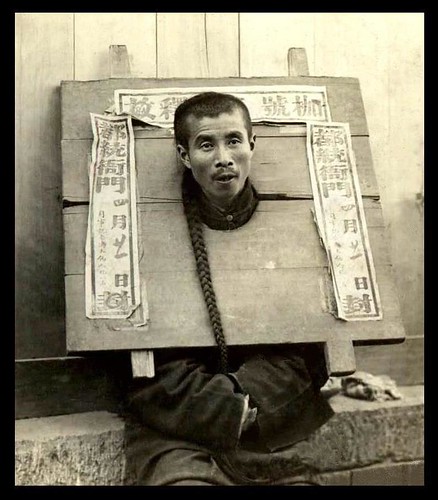
RESIGNED TO HIS PUNISMENT in OLD CHINA -- Living with the CURSE OF THE "CANGUE"  木枷

By nightfall they had cleared the forest. Omesa asked to accompany them back to Khanbaliq, and Beatriss, tired and unguarded, agreed. They camped together in the hills east of the chasm, where the wind smelled of ash and cedar.


There they met another wanderer: a gaunt man in an iron yoke, a debtor escaped from the mines. He begged for food and freedom, promising service in return. Beatriss fed him, and in the morning broke the lock. He swore to serve for a year before seeking his home in the Kobar Valley.


When they returned to Khanbaliq, Gwinch received Omesa as a guest and took the freed prisoner into his household as a servant. The priest declared the mission complete, and the Mehwa guards departed.

Beatriss said little. She had kept her promise, but her dreams were restless. The monk, the fox, the forest—each had found its way inside the walls.


Thursday, February 4, 2010

Report: Exploring Khanbaliq


red moons
Originally uploaded by biancavanderwerf

Gwinch received several visitors one morning: Gamo (senior) had sent his son (“Little Gamo”) as a household guard; a new laundress whom Gwinch soon recognized as Kishi; Beatriss, returned from her sojourn to Jangze.
These four, plus Saisho and three of Gwinch’s sohei went to survey the burned-out remains of Gwinch’s building project. He interpreted the rumors blaming Beatriss for the sudden fire as evidence of a combination of arson and slander.
Next, the party travelled beyond the walls of Khanbaliq to explore the ruins of the old city, in particular, the local Temple of the Two-Fold Path. Gwinch is a monk attached to a Two-Fold Path in Zipang and his superiors had sent him to Khanbaliq with a package for their sister temple. Because he’d been “quested” to deliver the package to the temple, Gwinch was anxious to discharge his responsibility, but he had some concerns. In an earlier visit, he’d found a strangely unwelcoming and deadly booby-trap near a secret entrance. So the party decided to set up a camp in the ruins a couple hundred yards away.
At their encampment, they were met by a beggar with whom they shared their food. During the conversation, Saisho used various spells to determine that this beggar’s mud-encrusted boots were in fact magical, having been created by the cat people to give the wearer silence in his movement. When Gwinch showed an interest in the boots, the beggar took his leave.
About an hour later, the party was visited by a gang of about a dozen toughs, looking to collect camping fees. When they became threatening, the party responded decisively, put the gang to flight and chased down and killed all but two or three of them. This attracted the attention of some months from the temple. Their interest in the dead bodies was neither especially positive or negative, but they were intrigued to meet “one of their own”—wearing Two-Fold robes, whom they did not recognize. The party accepted their invitation to the temple.
There they met Sheevani, a woman who introduced herself as the leader of the temple. She explained that she was not of the Two Fold Path, but that her own sect, brought with her from Manicea was very similar in the major tenets, and so they had formed an alliance. She accepted the package (a metal box) and was grateful for Gwinch’s offer of help. After a meager meal, the party departed.
They explored the ruins a little and found a large, intact house, surrounded by a high wall, its gate marked with various warnings. As dusk approached, they began to hear groaning and snarling coming from inside. They decided not to enter, and after passing by the Temple once more to see what happened there after dark (just some birds) they returned to the confines of the city.
The next day, Beatriss was visited by the guards from the House of Mehwa—they had forgotten to retrieve the master’s armor! It had been their duty to retrieve it, but in the excitement of the spiders and the weird house in the deserted village, they had forgotten. And none of them knew where he had fallen. Beatriss agreed that if they could wait a couple days, she would take them there.
In the meantime, the party decided to investigate the “poem” problem. While they had laughed off the series of insulting poems about them that had been posted in the green zone, they were now moved to do something about it. They began to become suspicious of Gamo, the one who had urged them to take action. By staking out his house, they confirmed that their “mentor” was in fact behind it, apparently trying to manipulate them into a feud against another family. In the process, they observed that another samurai, was in fact searching for them with the intent of avenging the death of his master Sato. This was Uesugi Kenchu, whom Gwinch had observed at the House of Lucky Dragon.


The party accompanied Kishi on a visit to herbalist in the Outer City. In the cellar herbalist, they met members of masked group who, without identifying themselves, thanked them (with a nice sum of cash) for their past service and enlisted their support for an up-coming mission to track down two traitorous generals in Chun Yuan province.


Finally, in the midst of these intrigues, a representative of the Emperor announced an up-coming martial arts tournament. None of PCs seemed interested in participating.

Tuesday, January 26, 2010

memories

The New York Times reports the confiscation of D&D materials in a Wisconsin prison

My first thought was that either myself or more likely, my friends (and probably not Isa or White Bear) should go visit him, maybe even smuggle in a clone "of the original 1974 fantasy roleplaying game that started it all."

Test: what level M-U would I be in so effectively killing so many birds with one magic missle spell? evading prison rules; giving comfort to an inmate; promoting old-school play; subverting the market advantage of a corporate brand name; making contact with a fellow, human D&D player-- oh, but wait . . .

. . . I read this: "Mr. Singer, “a D&D enthusiast since childhood,” according to the court’s opinion, was sentenced to life in prison in 2002 for bludgeoning and stabbing his sister’s boyfriend to death." And while I wanted to censure the reporter for such manipulative sentance construction, I remembered that in fact lots of human D&D players really are pathological shmucks, often in the face of my attempts at censure.

In-game conflicts between characters spill over into out-of-game conflicts between players. And vice-versa. (Litmus test: Which one do you find more regrettable? In the case of Mr. Singer, was Blackrazor involved? Did you let your DM date your sister? Was Blackrazor involved?)

Monday, December 28, 2009

Report: Beatriss and the charming peasant in Jangzy


Beatriss left Khanbaliq with eight soldiers from the House of Mehwa and four peasants hired as guides and porters. Just beyond the city gates they met two more travelers bound for Jangze—a cheerful young man and a weary young woman who trudged beside him in silence. The man introduced himself as Omesa, his smile quick and disarming, his manners refined beyond his station.

They journeyed together for most of the day—Beatriss and the two commanders on horseback, the rest on foot. Near afternoon they reached the moss-covered ruins of a temple. The soldiers proposed making camp there, but Omesa waved the idea aside. “If we press on,” he said, “we’ll reach Jangze before the moon climbs. You’ll sleep softer under a living roof than among the ghosts of a dead god.” His tone was light, teasing, and convincing.

Another hour brought them to a ravine spanned by a narrow footbridge. One soldier stayed behind with the horses while the others crossed. On the far side, the air turned cool and damp, and the forest grew dense. Pale webs glistened among the trees—vast, delicate, and eerily empty.

At dusk they reached the village. It was deserted. Omesa looked troubled but explained quickly that the villagers had fled to the hills because of the spiders—and that he, too, must soon follow. The four older peasants and the young woman departed in haste. Omesa lingered.

“You shouldn’t sleep in the open,” he said. “My house isn’t much, but it’s clean, and the trees will hide it from whatever walks at night.”

His hut stood at the edge of the village, simple but well-kept. He cooked rice and poured tea with graceful hands, making small jokes that even drew a half-smile from the weary soldiers. Beatriss found herself noticing the precision of his movements, the flicker of his eyes in the lamplight—an effortless charm that she distrusted but could not quite resist.

After supper, they set a watch. But before anyone could rest, sounds came from the trees: scratching, chittering, movement on the roof. The walls quivered. Hairy legs poked through the thatch. Beatriss gave the signal.

They burst into the night blades drawn. The spiders were as large as dogs. One forced its way inside and lunged at Omesa, who fought it off with a burning stick, laughing breathlessly—“You see? I’m not entirely helpless!”—until Beatriss cut the creature down.

By dawn, more than a dozen spiders lay dead. Four soldiers had been bitten and succumbed to the venom. The survivors carried the bodies to an empty hut. Omesa, his face pale but unshaken, suggested they “find a way to honor the living as well as the dead.” Beatriss rebuffed him curtly.

Exhausted, she fell into uneasy sleep. Her dreams were strange: laughter from the trees, a warm hand brushing her cheek, a fox’s tail flicking just beyond sight.

She woke to darkness, unable to move, pressed between damp earth and wooden planks. Overhead, she heard boots stamping on floorboards and called for help.

The soldiers pulled her up through a hole in the floor. The hut around them was not the neat cottage of the night before but a long-abandoned ruin, its roof half-collapsed, the walls thick with vines. Omesa was gone. They searched the village but found no sign of him—only pawprints in the mud, faint and sharp as though pressed by an animal walking upright.

Beatriss said nothing on the road back to Khanbaliq. But she dreamed often of the smiling young man who fought like a fox and vanished like a ghost.


Sunday, December 20, 2009

Play report: Beatriss in Khanbaliq


Playing with fire…
Originally uploaded by NaPix
Gwinch wanted to rebuild the dwelling place destroyed in the fire. He offered to assist with his know-how and the labor of his sohei followers in a rebuilding project. The landowner, of course, was very glad to have his assistance. The former tenants, however, were not to be found.


Beatriss pursued the rumor that there were other people “like her” (i.e. Cynadecian) living in Khanbaliq. Gamo (“Senior”) introduced her to an entertainer named Ashi who came from a faraway place where they spoke a different language and ate different foods. When she first came to Khanbaliq, Ashi stayed with other girls and young women and one of them looked so much like Beatriss that they could be sisters. In their brief conversation, it emerged that Beatriss was acquainted with Mehwa. This was interesting to Ashi because one of her friends, Kei-Lo had gone to his household. Ashi was glad to know Kei-Lo was happy there. She couldn’t say much about the Cynadecian woman, because no one could talk to her. Even when she was awake, she seemed to be dreaming.
Beatriss decided to explore the outer city on her own. She encountered a lost child who refused her help. She came upon the smoldering remains of a fire. Gwinch’s new construction had burned to the ground just like its predecessor. The gathering crowd pointed at Beatriss ("ash face") suspiciously.
On her way back to the “green zone,” Beatriss met with three peasants, who seemed to recognize her. No, they had not seen her personally, but they had her about her when she visited their region. They came from Jangze, a village a day’s trip to the west that was plagued by spiders the size of dogs. Beatriss had killed some spiders there already so maybe she would like to kill some more.?
They implied that it was a matter of duty. Because Beatriss had killed some spiders in the service of Mehwa, they hoped she would complete the job. Especially since the problem had become worse in the month since her visit—- had she done something to anger the spider spirit? Beatriss agreed to introduce them to Tehwa’s family.
At first, the family was more hesitant than Beatriss in offering assistance. But the peasants seemed to know a lot about Mehwa. It was rumored that he had promised his own daughter to the spider spirit. And it was breaking his promise (because isn’t Mehwa’s daughter going to marry someone here in Khanbaliq?) that had angered the spider spirit and had made the spiders attack the village. While the peasants didn’t believe these rumors about Mehwa and his family, other people might, especially if the problem were allowed to continue.
The family agreed to send eight of its soldier in company with Beatriss. Besides dealing with the spider problem, they were also recover the body of Mehwa-- or at least his armor.