Friday, March 4, 2022

Siege of Banua Day 3


Banua After the Siege

As later recounted in the Chronicles of the Northern Frontier

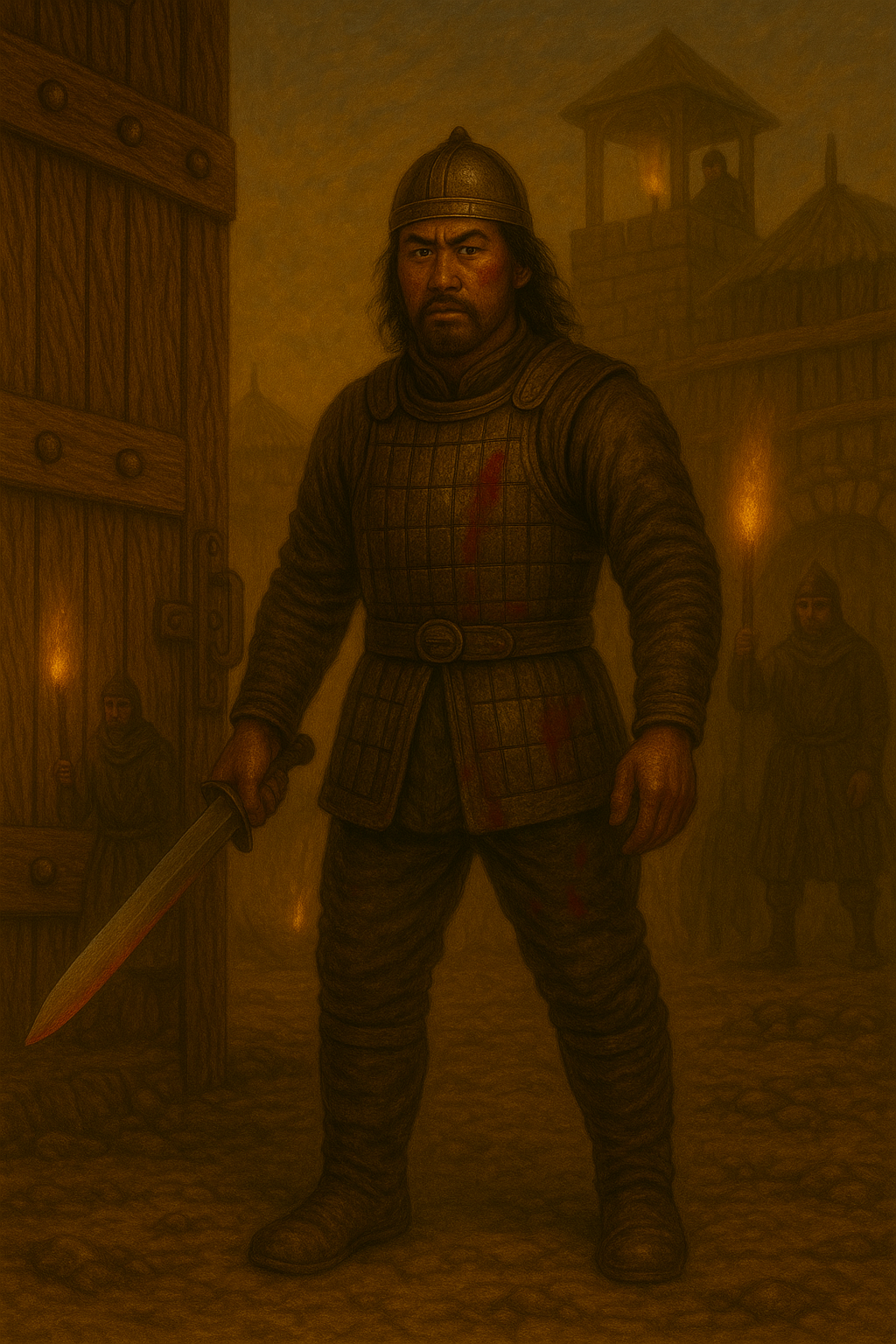
Bo-Jing rose early, his breath misting in the cold air as he stood atop the ramparts of shattered Banua. The fires had been stamped out, the beasts driven off. Victory, of a kind, had been won.

The warriors of the Bolad horde honored him with raised voices and lifted blades. They had seen him stand against horrors not born of nature — war machines vomiting flame, beastmen with the eyes of demons. Under his command, they had not broken. His companions, strangers just weeks ago, had shielded the innocent, destroyed siege weapons, and carved paths through the worst of the enemy.

But even as those cheers echoed in the narrow alleys, another sound rose — bitter, sharp, and raw. Grief.

It came from the Nergui.

They had buried their best beneath the rubble. Fathers, sons, daughters. The elders said they had been lured here, promised protection — and instead corralled into a slaughterhouse. Bo-Jing met their words with reason. You came of your own choice, he reminded them. But truth, in that hour, was no salve. Only salt in the wound.

And so the Nergui answered not with words, but with action.
“If we are to die,” they said, “we will die standing — not as shields for Ganbaatar and the Bolad.”

They did not speak again. They simply packed what was left: battered tools, limping beasts, orphans in tow. They left their dead where they fell, to be buried by the Bolad.
And then, they turned not west — not home. But southeast. Toward the lands of the Eagle Horde.

All save one.

Batzorig, son of Nergui, stood by the gate and watched them go. He did not weep. But he did not hide the tremble in his hands.

When they were gone, he turned to the ruins. His sister, Naransetseng, had been in Banua. She had not walked out with the others. No body had been claimed for burial. Her ger had burned.

He searched the rubble with Bo-Jing beside him, neither speaking much. Salt stood nearby, head bowed. Even Bangqiu — ever aloof — seemed touched by the loss. It was Bo-Jing who found it, beneath the blackened remains of the ger wall: Naransetseng’s necklace, unbroken, untouched by flame.

Batzorig fell to his knees. Clutched it like it might still be warm from her skin.

Bo-Jing looked to the smoke curling toward the eastern sky.

“She was not killed here,” he said. “I think she fled. Cast the necklace as a decoy. The beasts did not attack Banua — they passed it by. They’re still hunting her.”

Batzorig lifted his head, eyes red with dust and hope.
“Then I go after her,” he said. “Alone, if I must. Or with all the brave men who love what is beautiful and good.”

Bo-Jing clasped his arm. “You won’t go alone.”

And by dusk, the host rode out again. One hundred warriors, led by Bo-Jing, Bangqiu, Nar-Nuteng, and a man with hope clenched in his fist like a blade — chasing smoke trails and the memory of a woman who might still be alive.


Tuesday, March 1, 2022

Siege of Banua Day 2


At dawn, watchers on Banua’s towers saw the enemy encampments stirring. Beastmen began withdrawing, marching westward toward a long ridge. Despite their rout the night before, they still outnumbered the defenders three to one. Strangely quiet and efficient in their movements, they no longer resembled an undisciplined horde. It was as if an alien intelligence had assumed command.

Sensing deception, Bangqiu and Salt cloaked themselves in invisibility and set off to scout. Skirting around yetis scavenging the battlefield, the two magicians crept to the ridge’s crest—where they beheld a disturbing sight: the beastmen were clustered around a deep pit, excavating with inhuman speed. Lines of them marched out carrying dirt. Something was tunneling toward Banua—fast.

Among the monstrous laborers stood a solitary human in black armor. Without hesitation, Bangqiu and Salt unleashed a barrage of magic missiles, driving him into his tent. To compound the chaos, Bangqiu summoned a stone wall and dropped it across the mouth of the tunnel. Then, taking the form of an owl, he flew back to Banua. Salt, cloaked and cautious, made her way back on foot.

That night, few slept. Red flashes lit the sky. The ground trembled. Rumors raced: the well water tasted wrong. People heard screams beyond the ridge.

Before dawn, watchmen saw movement: beastmen advancing again—this time with giants and juggernauts.

Ganbaatar organized the defense. Armed soldiers manned the battlements. Citizens were herded into the inner barracks.

Then, the earth split.

Right beneath the inner gate, a colossal claw burst through the ground, ripping stone and earth apart. The gate crumbled. Up rose a monstrous, red-eyed badger—taller than two men, its snout dripping with hunger. It lunged. A slash of its claws cleaved a soldier in half. Its jaws snapped a horse’s spine.

Soldiers fled. The beast pursued, killing, devouring.


Then came Bo-Jing. With him stood his henchmen, also Nar-Nuteng, and all of the bravest warriors of Banua. Long spears drove into the beast’s flanks. Arrows peppered its back. At first, it seemed unstoppable. But a spear found its underbelly. It halted. Bo-Jing leapt forward, slashing deep into its face. Nar-Nuteng struck beneath its foreleg. Surrounded and bleeding from every side, the beast collapsed—its death shaking the earth again.

But chaos reigned.

Beastmen had scattered into Banua, setting fires, slaying unarmed townsfolk, killing livestock. The juggernauts arrived next—three immense engines of war—rolling toward the outer gate. With the city’s defenders drawn inward, the gates fell. The juggernauts rolled into Banua.

But the magicians were ready.

Bangqiu, Hyamsam, and Salt struck the wheels of the lead juggernaut with fireballs and magic missiles. Flames erupted. The behemoth veered, tumbling into the pit torn open by the badger. The others crashed in behind.

Still, the beastmen pressed toward the marketplace—toward the tents of the Nergui refugees. Arrows rained down from the rooftops, but the monsters moved from tent to tent, slaughtering the defenseless.

Then Bo-Jing and Nar-Nuteng returned.

Rallying Banua’s remaining warriors, they charged. This time, the beastmen broke. Driven into a corner of the marketplace, they were caught, surrounded, and destroyed.


Friday, February 11, 2022

Siege of Banua Day 1


As the sun went down, the people of Banua feared an attack from the besieging horde outside. Beyond the walls, bonfires blazed, and gusts of wind carried the sounds of aggressive chants punctuated by screaming; in certain parts of the city, a deep rumbling in the ground shook the tent poles. The sky flashed red with fire to illuminate the forms of giant flying lizards. When the horde charged, the archers of Banua were ready. Arrows rained down on the onslaught of beastmen, trolls, and yetis. Still the monsters pressed in a crazed fury, many with multiple arrows embedded in their flesh. Pondering behind the hordes of beastmen was an enormous wagon with an iron head. Arrows bounced off it harmlessly. Beastmen who stumbled before it were crushed underneath its thick, spiked wheels. As it reached the gates of Banua, the town’s defenders began to pelt it with stones. These missiles barely damaged the juggernaut, and did nothing to slow its progress. When it reached the entrance to the town, it began to rock back and forth, ramming its iron-shod head against the wooden gates. Bo Jing directed the defenders to direct their fire at the beastmen who were scaling Banua’s walls.

Bo Jing called on the power of the Coin of East to freeze the wheels of the juggernaut. He and his henchmen joined the defenders in killing the attacking beastmen; their bodies began to pile up at the foot of the walls. Once the beastmen’s onslaught was neutralized, the defenders resumed their efforts to destroy the incapacitated juggernaut. The strongest men attacked it from above, casting down huge stones and barrels of flaming oil. At this moment, Bo Jing received word of another attack in another part of the town. Dragons had descended from the clouds into the midst of the crowded mass of yurts behind the Khan’s palace. They were devouring people and setting fire to their homes.

Bo Jing and his men, rallied the most capable of Banua’s defenders and dashed to the rear of the town to confront the dragons. There were two fearsome beasts, surrounded by burning wreckage. Bangqiu and Salt, from the safety of the Khan’s palace, blasted one of the dragons with magic missiles. Enraged, it took wing, flying toward them. Bo Jing and his men to attack the second dragon, striking it from all sides with swords and spears. The dragon thrashed from side to side, desperate to seize and devour a hapless spearman. But Bo Jing, with astounding bravery and quickness, stayed at the dragon’s head, slashing at its eyes and mouth, denying it the opportunity to strike. The dragon weakened and Bo-Jing saw his opportunity. He rushed toward it, feinted to the left and, as the dragon went to the right, dashed past its open maw and slashed its throat with his long sharp sword. Black blood gushed out and the dragon died. The flying dragon, meanwhile, had made itself a target for archers throughout the town. Pierced with many arrows, it floundered and crashed to the ground, never to rise.


Sunday, October 24, 2021

Defending the Lands of the Five Fires 05 (First Khazu-Kala and then Banua)


Bo-Jing, Bangqiu, and Salt decided they would go to Khazu Kala. Expecting a difficult battle, Bo-Jing ordered that they make a comfortable camp and rest for a couple days, giving their wounds a chance to heal. 

And so, by the time they reached Khazu Kala, the battle was all but over. A single wizened creature, wielding a rusty wicked sword, stood surrounded by a dozen Nergui warriors—and also dozens of corpses. Bo-Jing, riding on Ses-Hami, arrived by air and Bo-Jing attacked the strange fiend with a flying leap. With his fiery sword, Bo-Jing dispatched his foe and won the admiration of the Nergui. 

Gansukh was dead and his name had the taste of ashes. His duplicity had brought his own death, the deaths of his loyal bodyguards, the deaths of the people who depended on him. With little argument, the survivors of the attack, both the warriors and the people, agreed they would join Bo-Jing. Yes, even in rejoining the Bolad horde in Banua.

It took three days to arrive within sight of Banua and the arrival was not a cause for celebration, but another serving of hardship. For the proud city of the steppe was surrounded by an army of beastmen, dragons, and monsters. Bo-Jing himself cursed bitterly at how the pettiness of Gansukh had brought such horror among the people he had agreed to protect. But Salt would not allow her friend the luxury of despair. She directed his gaze from his foes to the people who now trusted him. With courage and faith, he could bring these people into Banua. Reuniting the people of Bolad and Nergui did not guarantee their survival but preserved their hopes for another day.

Bangqiu became invisible and rose into the air, surveying the enemy camps, and determined the safest route to the city. Bo Jing received the information and led the way. The Nergui warriors formed two files around their families and herds. They raised their swords and shouted as they approached, making themselves appear to be another war-band arriving to join the assault on Banua. The beastmen accepted the deception, cheering as the Nergui passed through their lines. Bangqiu, invisible, flew into the city and alerted the defenders to the ruse. When the gates were opened, Salt and Bangqiu blasted the band of beastmen who tried to join the people of Nergui. The unarmed people passed into the city. Bo-Jing and the warriors stayed to defend their entry, warding off more attacking beastmen. Only when the innocents had entered the city did the warriors follow. Bo-Jing entered last of all and the gates were closed.


Defending the Lands of the Five Fires 04 (The truth about Batzorig's sister)


Npi-Nhut and the other khimoris thanked Bo-Jing for his assistance. They promised to keep watch over the valley and alert him to any more incursions. And, as a further sign of appreciation, Ses-Hami would accompany him as he made his way to Khazu Kala. Bo-Jing was especially grateful for the khimori’s assistance as a scout and promised his father to not expose him to unnecessary danger.

The company made their way out of the valley, Ses-Hami sometimes scouting ahead when they reached likely ambush points. They reached the watch fire of the Nergui horde and were given a cold welcome. The soldiers shrugged off Salt’s questions about the beastmen and rather than share their ger, sent the guests to sleep among the firewood. 


The company, still including the eight men from the Worm Clan, departed early the next morning and not far from the edge of the valley, heard the sounds of battle. Drawing closer, they found a Nergui encampment under attack by beastmen. Bangqiu broke the beastmen’s charge with a wall of fire then levitated above them to blast them with a cloud of steam. Salt cast her magic missiles and the few stragglers were cut down by Bo-Jing and his men.


The families in the camp offered thanks and, recognizing Bo-Jing’s status as a local baghatur, pledged their loyalty to him and the Emperor. They shared a meal and, though hesitant at first, voiced their discontent with Gansukh. Many had avoided Khazu Kala, waiting for a sign. Over the course of the meal, as they listened to the grim tales of the Worm Clan, they began to believe that Bo-Jing was that sign. The invaders welcomed by Gansukh were worse than they had feared. If anyone could rally resistance against the armies of the mysterious “Master,” it was Bo-Jing.

Among the group were three skilled archers and a retired officer from Gansukh’s army. They vowed to support Bo-Jing when the time came, though their first duty remained to their families.

Later that day, Ses-Hami alerted Bo-Jing to another camp under attack. Bo-Jing and Bangqiu again led the counterattack. Several warriors from the camp joined the fight, and one of them proved to be Batzorig—formerly Gansukh’s right hand, and brother to Gansukh’s khatun, Naransetseng.

After the battle, Salt warned Batzorig that Naransetseng was in special danger: the beastmen had been searching for her among the Worm Clan.

Batzorig’s scarred face went soft. His lip quivered. He nodded, then shared his story.

“I overheard Gansukh speaking with a stranger. At first, I thought it was another black shaman—someone after her necklace. But I listened more closely. The man didn’t want the necklace. He wanted Naransetseng.”

As trust in Gansukh eroded, many people of Khazu Kala made secret plans to flee. Batzorig had persuaded his sister to join them. He remained behind, pretending ignorance—a role Gansukh accepted, perhaps too willingly.

“It was easy. My brother-in-law was afraid of her, and he avoided her. But then... the stranger returned. He brought half-man monsters. And suddenly Gansukh demanded I bring her to him.”

Batzorig stalled. He told Gansukh that Naransetseng had gone to visit their mother’s grave—three days west of the city. Gansukh had raged. And then he had despaired. The stranger promised to return.

“That was four days ago. I stayed close, in case Gansukh needed me. Because... he’s my khan.”

Batzorig turned to Salt, Bo-Jing, and Bangqiu.

“My sister is deaf, but she is not a witch. She’s the daughter of the King of the East. When we were children, my mother was alone—my father and uncles were at war. One day, a man came to our camp. He wore green and played the fiddle. He helped my mother... stayed with her... and then Naransetseng was born. Before my father returned, the man left, but he gave her a necklace.”

He looked down at his hands.

“She was beautiful. She believed our father—the man who raised her—was the squat, scarred soldier who came home from war. An ugly man, look at me, my face was his face! And he loved my beautiful sister more than anything. More than me, I think. She was not deaf when she was born.”

Then, almost in a whisper:

“But the stranger... he knows who she really is. That’s why he wants her.”


Sunday, September 12, 2021

Defending the Lands of the Five Fires 03 (Not the coin they were looking for)


Over the next few days, the party was joined by the remnants of the Khimori herd—Npi-Nhut, Ses-Hami, and only three others. Then they were attacked by the lion-eagle creatures. These beasts were fearless and seemed driven by hunger. They targeted the party’s extra horses, swiftly killing two and carrying them off.

Salt reacted immediately. Bo-Jing had given her a magic wand, and she used it to unleash an explosive ball of fire as the creatures fled. Those not killed were forced to land. Bo-Jing and his men galloped after them, fighting with arrows and swords. The brave warriors were grappled by talons and slashed by claws, but they defended each other and killed the monsters.

The Khimori expressed their gratitude, praising the party for slaying enemies they had come close to believing were insurmountable. Ses-Hami examined the bodies and told Bo-Jing he believed six more remained—including one that was invisible except when attacking. Bo-Jing assured Ses-Hami that he and his company would remain in the valley until the threat was eliminated.

Bangqiu then suggested that while ranging over the northern end of the valley, they should search for the Northern Coin. Bo-Jing agreed. Following Erke’s earlier hints and their own knowledge of the valley, they located an enormous horse statue, which they reasoned must represent the King of the North. Bangqiu climbed it. Following the statue’s line of sight, he spotted a high cliff to the north, pockmarked with caves. From this vantage point, he also saw figures moving outside—possibly human, possibly animal, likely something in between. The company decided to rest and approach the cliffs the next day.

While resting, they kept a close eye on the figures. The next day, they climbed to the cliffs and encountered a group of beastmen, clearly agitated but held in check by a robed man—Erke, the mysterious traveler they’d met in Khanbaliq. He greeted them like old friends, apologizing for having left Banua without them.

“I didn’t know when you’d return. And as you can see—I found some new partners!”

Erke explained that, with the beastmen’s help, he’d located several tunnels, one of which surely held the Northern Coin.

“Unfortunately, these are the breeding grounds of the crimson death worm. Watch your step—or your last breath will be a cry of agony!”

Beastmen from the Clan of Worm tapped their crimson shields and laughed.

Erke added that most of the beastmen had died exploring.

“They almost never watch their step...”

Salt found the beastmen unsettling. Their musky odor was overpowering, and they stared at her with bloodshot eyes and drooling fangs, whimpering when Erke shouted at them in a harsh metallic tongue. Their glowing marks oozed blood and pus as they scratched at them.


Erke pointed out the tunnels he had explored and suggested sending in the beastmen first to draw out the worms.

“Your men can shoot them—the worms—before they shock us. And if all the beastmen die, we won’t have to pay them. Speaking of payment, I’m working for the Emperor. He expects the coin, but we’ll all be well rewarded.”

Bangqiu and Salt rejected this at once. Salt didn’t believe Erke. Bangqiu didn’t care.

“We don’t work for the Emperor,” Bangqiu said. “If we find the coin, I want it.”

As they argued, Erke lost control of the beastmen, and they attacked with fury. Erke pulled a potion from his robes. As his body sublimated into a blue-green cloud, Salt fired a ball of flame from her wand. The cloud evaporated and two beastmen were incinerated. The rest attacked.

At that moment, a screech from above heralded another assault. The lion-eagles returned. As the Khimori took to the sky, the beasts targeted the party’s horses. Bo-Jing and his soldiers outnumbered the beastmen, who fought with a death-wish. Four horses were killed before Salt and Bangqiu drove off the lion-eagles with magic, killing one.

Knowing another attack could come from any direction, the party set camp with many watchers.

After a day of rest, Bo-Jing and Salt chose to explore the tunnels. The Worm Clan refused to follow.


“The death worm is our totem,” they said. “We must warn you—if molested, it will defend itself with poison, needles, lightning... But if it spares you, so will we.”

Bo-Jing promised to avoid unnecessary violence, believing the coin could help in the war against the Master. Bangqiu chose to remain outside to guard the horses—and to keep an eye on the Worm Clan.

Bo-Jing, his men, Ryu, and Salt ventured into the tunnels. The warnings proved accurate. Gan-Yul was bitten and his leg swelled painfully, but he survived. The party cleared the path with long poles, using rocks to kill worms from a distance. Most effective, however, was Ryu’s snake staff. As a giant python, it drove out the worms, crushing and devouring them. Even when bitten repeatedly, it endured, only reverting to staff form when finally overcome.

The nest they found covered an older, human-made tunnel. After crossing a chasm, they entered a small chamber. A bronze coffer rested on a stone pedestal. Though small enough to hold, it was too heavy to lift. Bo-Jing summoned all his strength to knock it off. Something clattered inside.

From his pack, Bo-Jing retrieved a bottle of vinegar he’d found in Khanbaliq. While his men gagged, he drank it down and, with a great shout, smashed the coffer open. Inside was a dull metal disk, possibly pewter, with four doves flying in a circle—no symbols, no writing. Ryu read the accompanying scrap of paper:

“Where your treasure is, your heart will be also.”

Outside, Npi-Nhut approached Bo-Jing with a plan. He believed Bo-Jing was honorable, but the lion-eagles would return. Many more horses—and people—might die. The Khimori couldn’t fight effectively while carrying riders, but Npi-Nhut was willing to make an exception. Each would carry one fighter into the aerie.

Bo-Jing agreed. Ryu volunteered. Bo-Jing chose Gan-Wei and Yi-Ren. A dilemma arose over whether to take Zhang or Gan-Yul—Salt resolved it by volunteering herself. Npi-Nhut approved, noting her uncanny timing in battle.

They flew by moonlight. Salt pressed her face into Npi-Nhut’s mane. Bo-Jing, riding behind Npi-Nhut on Ses-Hami, held tight, his legs aching. At dawn, they reached the southwest cliffs.

Npi-Nhut signaled. The Khimori circled, then dove. Two lion-eagles were visible. As Npi-Nhut feinted, the others dropped their riders. Bo-Jing landed on one, severing its wing. Gan-Wei and Yi-Ren flanked the other. Ryu landed and released his snake staff.

Salt remained airborne. The wounded lion-eagle screeched. Two more emerged—and then the invisible one struck Bo-Jing, pinning and slashing him. Salt blasted it with bolts of energy. Bo-Jing tracked it by claw marks and gusts of air, striking again and again.

Gan-Wei and Yi-Ren killed one, but struggled with the next. Ryu’s snake immobilized it long enough for Gan-Wei to finish it. Ryu healed Yi-Ren, then joined the fight with his staff. Salt hit the invisible foe with magic again.

It screeched and flew—Salt bathed it in violet light, revealing it to the archers. Struck by arrows, it dove. Ses-Hami chased it to the ground. Though wounded by its talons, he threw it off, then pounded its head with his hooves. The others arrived to find the final beast dead.

Back in the aerie, Bo-Jing found a fine sword among the bones and gave it to Gan-Wei.

Monday, July 12, 2021

Defending the Lands of the Five Fires 02 (Into the Valley)


The party returned to Banua and shared news of their success at Sum Sukhis. Ganbaatar was thoroughly pleased and announced a small feast in their honor.

The celebration was muted, however, by the growing evidence that their recent triumph, however symbolically important, had done little to address the danger now gathering around them.

The population of Banua had noticeably increased during the weeks Bo-Jing and his company had been away. The most obvious newcomers were members of the Bolad horde returning to the seat of their khan, as was their right. But more and more of the new arrivals were refugees from the Nergui horde.

They were not soldiers.

They were families. Widows. Children.

Ganbaatar called them his “long-lost people returned,” deliberately striking a tone of generosity rather than conquest. Clearly, Gansukh had not been able to defend his people as well as Ganbaatar.

But an uncomfortable question hung over Banua.

Would “better than Gansukh” prove to be good enough?

Bo-Jing discussed the matter with Ryu and came to the one obvious conclusion. As an Imperial baghatur, he was not Ganbaatar’s man and he was not a partisan of the Bolad horde. His commission might have brought him north to collect taxes, but it also gave him responsibilities to the people of the frontier, Bolad and Nergui alike.

He would go to Khazu Kala.

He would make peace with Gansukh if possible and, regardless of whether he succeeded, find some way to bring help to the people there. If he could not organize a defense himself, he would gather enough information to make a compelling report to the Imperial authorities.

The mysterious Salt had also found her way to Banua.

Bo-Jing suspected that Bangqiu had somehow contacted her through the dreamworld. Regardless, he was glad to have the advice of another magician before confronting the armies of the “Master.”

Another newcomer also volunteered to join them.

Nekhil was a wandering warrior with a poor horse, shabby leather armor, and little besides his spear. His explanation was simple.

Every shaman deserved a bodyguard.

Salt, apparently finding nothing unusual in this arrangement, accepted his protection. Bo-Jing welcomed Nekhil into the company.

Nar-Nuteng, however, made a different choice. She respected the customs of her people and the ancient taboo against entering the Valley of the Five Fires. She would remain in Banua.

And so Bo-Jing departed with Bangqiu, Salt, Ryu, Nekhil, and the usual members of his retinue.

En route to the lands of the Nergui, they encountered a khimori—a blue-black flying horse—who introduced himself as Ses-Hami, son of Npi-Nhut, the khimori Bo-Jing had previously met in the Valley of the Five Fires.

Ses-Hami brought grim news.

The Valley had been invaded by evil creatures who defiled the cradle of humanity with wanton bloodshed. They fought one another, killed animals, and set the grasslands ablaze.

At first, the khimori had been able to avoid the danger simply by taking flight.

Then the land-bound monsters were joined by flying abominations: lions with the heads and enormous razor-sharp beaks of eagles.

These creatures could pursue the khimori into the sky.

Several of the herd had already been killed. Without assistance, Ses-Hami feared the rest would soon be eliminated.

Bo-Jing immediately promised to help.

That night, however, he slept badly.

He had been traveling toward Khazu Kala because frightened people needed him. Now he had promised aid to the khimori as well. Every detour carried a cost, and Bo-Jing found himself wondering whether the promise he had just made might eventually be paid for in human lives.

By morning, he had reached a decision.

Helping the khimori might also help the people of Khazu Kala. If nothing else, entering the Valley would teach him something about the creatures causing such havoc throughout the northern frontier.

The company turned toward the Valley of the Five Fires.

On the approach, they passed through the Bolad fire camp that guarded one of the traditional entrances.

It had been completely destroyed.

Every firewatcher was dead.

Bo-Jing and his companions crossed into the Valley.

There they encountered a group of haggard soldiers carrying crimson shields.

The strangers reacted with open joy and relief at the sight of other natural people. They identified themselves as warriors of the Clan of the Worm and told a story much like the ones Bo-Jing had already heard elsewhere.

Their lands had been overrun by beastmen.

The creatures attacked without reason or apparent purpose except for their obsessive search for two people they called the “deaf witch” and the “queen with no name.”

Circumstances had become so desperate that the Worm Clan warriors had broken the taboo against entering the Valley of the Five Fires. Their plan was to cross it, warn their treaty-partners among the Nergui, and begin organizing a common defense.

Bo-Jing thanked them for the warning and agreed that all people threatened by the invaders would need to stand together.

He believed the “deaf witch” might be Naransetseg, wife of Gansukh, khan of the Nergui horde.

He intended to accompany the Worm Clan warriors toward the Nergui lands.

But first, he had made a promise to the khimori.

The men of the Worm Clan asked to travel with him. They had seen enough already to recognize in Bo-Jing a true baghatur of courage and honor.

Bo-Jing welcomed their help gladly.

Not long afterward, the enlarged company encountered several of the beastmen the Worm Clan had described.

What they saw was worse than expected.

These did not appear to be creatures born as beasts. Beneath the claws, fangs, and strange tattoos were recognizably human bodies caught in the midst of some agonizing transformation.

The creatures were fearsome opponents.

Bangqiu and Salt struck first, blasting them with scalding steam and other magic. Those who survived were swiftly cut down by Bo-Jing and his men.

The Worm Clan warriors pledged their gratitude for having been accepted into such valiant company.

Some time later, Ses-Hami approached Bo-Jing privately.

There was something he had not told him.

His father, Npi-Nhut, had been captured by the beastmen.

The creatures had offered Ses-Hami a bargain: deliver Bo-Jing to them, and they would spare his father.

After traveling with Bo-Jing, Ses-Hami had come to understand that he was not merely formidable but honorable. And he knew his father would rather die than purchase his freedom with the betrayal of such a man.

Ses-Hami also knew where the enemy was waiting.

The beastmen and other monsters had prepared an ambush along the main path into the Valley, expecting Bo-Jing to pass beneath them.

But Ses-Hami knew another route.

A narrow path through the forest climbed even higher than the ambush point.

If Bo-Jing agreed, they could approach the enemy from above, rescue Npi-Nhut, and turn the ambush against those who had prepared it.

Bo-Jing agreed immediately.

Ses-Hami led the company through the forest and eventually to the crest of a steep grassy slope overlooking the main path below.

The khimori had spoken the truth.

A group of beastmen and three trolls waited above the path. They had assembled a great mass of rubble, held in place by logs and ropes, ready to be released onto anyone passing beneath them.

Nearby, Npi-Nhut stood chained to a rock.

Three enormous wolves guarded him.

Bangqiu rose into the air.

From above, he cast down a ring of fire around the would-be ambushers. The flames expanded, trapping the beastmen and trolls inside.

The Worm Clan warriors loosed arrows into the surrounded enemy.

The wolves charged uphill.

Bo-Jing ordered his men to concentrate their arrows on the animals while he stepped forward, sword ready, to meet whatever survived.

Salt added her own magic to the volley.

Two of the wolves fell before reaching the company.

Only one reached Bo-Jing.

He killed it with a single blow.

Below, the ambushers tried desperately to escape Bangqiu’s burning prison. Some were consumed by the flames. Others managed to break free and charge uphill, only to be overwhelmed by Bo-Jing and his men as they reached the crest.

Soon the monsters were dead.

Bo-Jing’s company had turned an ambush into a complete victory.

And not one of them had fallen.

Npi-Nhut was freed from his chains.

He confirmed his son’s account and expressed pride in Ses-Hami’s choice.

The elder khimori announced that he would gather the surviving members of the herd. With Bo-Jing’s permission, they too would join the growing company as it continued its campaign through the Valley.

Bo-Jing agreed.

The party that had entered the Valley seeking information was becoming something else.

Everywhere they went, survivors were choosing to follow.