Tuesday, April 8, 2014

About OA6 "Ronin's Challenge" (1990)


The victory of Beatriss and Tetsukichi in Tempat Larang marked the end of my use of OA6 Ronin's Challengeover a three-year span!  It’s not a great module, but it’s very useful in some ways, and given that I may have spent more time with it than anyone, I’d like to share a few thoughts on how to make it useful to you.  After all, it’s a freedownload.

Background, specific to my campaign:  My use of the module began when Gwinch received the mission from the Emperor to track down the rogue General who he’d sent to deal with a rogue Governor.  After about a year-- and no word from Gwinch-- the Emperor decided he needed a cat to catch the birds he sent to catch the spider sent to catch the fly . . . and he called on Tetsukichi.  Both Gwinch and Tetsukichi were supported by other PCs and NPCs.

 The geographic area of the adventure is enormous, comprising a series of valleys based on real world cultures across Southeast Asia from Yunnan Province China to Indochina (Thailand, Laos, Vietnam) to Indonesia.  The physical scale of the adventure might not be quite as large as its real-world model, but it is close.  These valleys are roughly 100 miles wide and choked with jungles and swamp.  In dealing with the question of how adventurers could have any practical hope of crossing such a wilderness in pursuit of their goal, the adventure relies rather heavily on plot coupons—there’s a chance encounter with a sultan who tells them a story about a pirate trapped in a tomb, and if the pirate is released he tells them about such-in-such . . . .  It’s a sandbox that assumes DMs will build a railroad.  There are other ways to give the adventurers a way to pursue their quest without waiting for things to fall into their lap. I made the following decisions:

Many of the people the PCs encountered had a stake in their quest, because the mini-war between the General and the Governor was something that affected their lives.  The adventure includes a good way of stitching everything together, but doesn’t develop it properly.  There are some allusions in the random encounter tables to the fact that the rogue general and the rogue governor, each with his own army played a cat-and-mouse game across this area, and that the adventurers should encounter ruined villages and burned fields.  But this is treated as just background material.  As I ran it, when the PCs arrive at a large town (Pasar), there were able to find people there who encountered these armies, and can give some insight into what they were trying to do and what they might have been looking for. 
The devastation caused by the Governor and General created lots of potential adversaries for anyone else passing through.  The adventure also has a weird sub-plot about one of the Emperor’s advisers sending her own men to spy on the PCs (following them over hundreds of miles!).  Instead, I reasoned that deserters from the armies had set up shop as slavers and marauders throughout the region.  So rather than simple encounters, I had good material for developing side adventurers.  This also broke up the slog of “the longest backpacking trip ever,” but without taking away from the feeling that it was a grueling, dangerous journey.  Plus they were another, more natural source of information that propelled the PCs forward in their quest.

Underground shortcuts are at least half of what makes D&D great.  The adventure includes one labyrinthine mini-dungeon.  It had a cool atmosphere, being flooded with slightly acidic water that the adventurers had to navigate with miniature canoes.  But the individual encounters, beyond the swimming zombies, started to pall after a while.  Later groups of PCs found other ways to pass through the same mountains.  Some of the tournament modules, with their gauntlet-style series of challenging puzzles and encounters were very useful to me here. 

The various ancient buildings with cool powers and useful information are all located in Tempat Larang.   As written, the adventurers should discover a library, and observatory, and a shrine before they arrive at the climatic encounter in Tempat Larang.  There are a couple reasons why this wroks better in a movie or video game better than in an RPG.  First, in passive media, the protagonists' progress from one far-flung location to another just happens.  There might be obstacles along the way, but the audience doesn't notice that the protagonists rarely have to stop and ask for directions.  In an RPG, the automatic scene-shifting feels more jarring and contrived.  Forcing PCs to figure out where they want to go and how to get there adds depth, but can become tedious, so it's good to have just one final destination rather than several.  Second in movies/graphics-based games, the visual element comes cheap and can compensate for deficiencies in other areas.  In RPGs, the big challenge is helping everyone visualize the surroundings.   I wanted this ancient ruled capital to feel like an ancient ruined capital and to do that I needed buildings.  I used some other modules, including Faster Monkey’s Mor, to develop the layout of the larger city.

Run the climatic encounter as it’s written.  It feels a lot like a video game—the PCs take turns controlling a spirit dragon, with a dizzying selection of magic powers, while their enemy— after each “defeat”— takes on a new, more fearsome form, until it’s finally destroyed.  It was really fun for everyone.

(As a side point, the martial arts tournament has no meaningful connection to the rest of the adventure.  It's just a way for  the Emperor to take notice of the PCs.  Their main rival in the tournament has a shadowy backstory and he pops up throughout the rest of the adventure, giving one the sense that he has some interest in the tournament beyond the obvious.  But it seems that he just really wanted to win that martial arts tournament and that's it.) 

I used to think it would be cool to have a paladin based on Immanuel Kant

But someone has beat me to it . . . http://existentialcomics.com/comic/23

Monday, March 3, 2014

Victory in Tempat Larang


The altar of Nung Chiang, according to Afu, who saw it at the Observatory, was local to the unnamed village where the party had been resting for the past several weeks. The party returned to the village and sought out the shrine and the altar. Screened by the plants of the jungle, several members of the party had, during their weeks in the village, walked near it without seeing it. They sat on the ground, Afu began to pray. The smell of cooking rice filled the air, mixed with the smell of flowers. A man with golden eyes appeared, and they all understood that he was also a dragon. He asked him why they had come. Tetsukich and Beatriss explained. He told them he would give them the power to defeat General Goyat. They should return and confront him in the Courts of the Seasons, near the citadel where they had already met him. What does he want with Gwinch? Beatriss asked. Nung Chiang explained that Goyat wanted the blood of an outlander to awaken the sleeping army. "Good thing we didn’t bring him here."  "Yes."

The party made their plans to go back down into Tempat Larang. They couldn’t find the sinkhole that led to the lair of the snake people from which they’d emerged several weeks ago. They met some hunters in the jungle who sowed them some strong vines that grew from trees at the top of the cliff and dangled all the way down into the city. There was a problem. One of the hunters shook a vine. Giant wasps emerged from a hole in the cliff. Everyone ran into the jungle to take cover. Beatriss paid the hunters with a gem they’d taken from the black dragon and enlisted their help in killing the wasps. Everyone prepared an arrow, while one of the hunters went to shake the vines again. After several seconds, two wasps, each the size of a sheep apeeared at the top of the cliff—and were shot down with arrows. Then Beatriss decided she would climb down. Asking the rest of the party to cover her, she drew her sword of invisibility and started to climb down the vine. (No one asked her to explain.) She chose a section far from where she’d seen the wasps emerged and was cautious to shake the vine as little as possible until she reached the part of the cliff where she’d seen the wasps emerge—there she moved more quickly. She caught a glimpse of the wasps papery nest but saw nothing moving and didn’t linger to look more closely. It wasn’t until she reached the bottom, that she saw two more wasps crawl out. These crawled up the vines, then flew to the top to be shot by arrows.

As they moved through the city toward the citadel and the Court of Seasons, the party were distracted by another large, intact building, several stories tall and adorned with numerous turrets, balconies, and statuary.

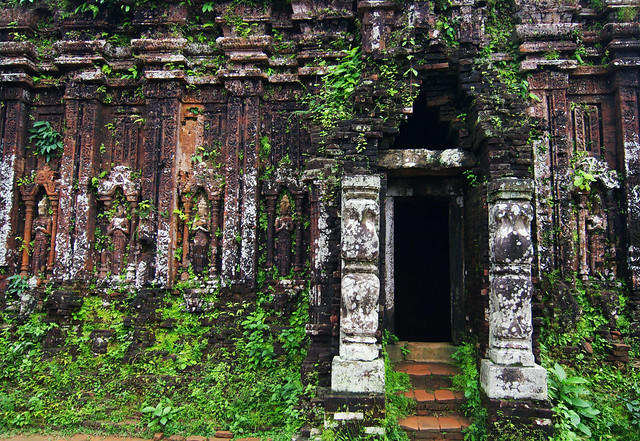
Mỹ Sơn
Circling it, they found an archway where, under the vines, they hoped they might find a door. As they approached, the vines lashed out to attack them, entangling their limbs. They broke free or hacked free without losing anyone to the strangling vines, but decide to leave exploring that building for another day.

When the party reached the Citadel General Goyat emerged to meet them, twitching and smiling. He asked for Gwinch, and Beatriss answered, “We don’t have him.” Under their breath, she and Tetsukichi began reciting the incantations for summoning Nung Chaing. Even before they began, a thing white mist began to blow in from above the city.

Goyat’s smile turned into a sneer. “I have given you more than enough time. Useless! You will be destroyed.”

The wind grew stronger, blowing away the layer of ash that covered the ground and revealing the colored quadrants of the Seasons of the Courts. Beatriss and Tetsukichi did as Nung Chaing had instructed. Tetuskichi took his position in one court—choosing that of Winter while Beatriss chose the court of Spring. Their companions stayed close to them, but on the edge of the Courts of the Seasons.

Barongsai Peh CunThe mist thickened into a dome, and a golden dragon swooped in from the top just as the dome closed at its apex. Goyat, his face twisted into a terrible grimace called for the help of the powers of darkness. A bolt of black lightning sliced through the mist-dome and struck Goyat. He turned into a pile of cinders. The cinders throbbed and pulsated and then took on the shape of a giant man of black stone. The stone cracked, revealing the face of Goyat. Beatriss and Tetsukichi fainted and collapsed to the ground. The Dragon attacked the stone man.

The Dragon turned from gold to silvery white as it summoned javelins of ice from the mist and hurled them at the stone man. The stone man broke off chunks of buildings and hurled them at the dragon. The rest of the party struck at the stone man’s feet with their swords or chanted a prayer of support for the dragon. Next the dragon turned gold and descended, slapping the ground with its tail. A tentacle of stone sprang up and grasped the stone man as the dragon returned to the air, turning first red and then black. The stone man continued to swat the dragon and hurl stones. The dragon resumed its white color and hurled more ice javelins, destroying the stone man.

As the stone man crumbled, hundreds of soldiers began to rise from the dust. Although each soldier could be obliterated with a simple swing of a sword, they were utterly fearless, and attacked without ceaselessly, swarming out of every crack in the ground. The hardiest members of the party guarded the defenseless bodies of Tetsukichi and Beatriss. And the dragon cycled through its seasons: Silver to Gold to Red to Black. It settled on the ground in the midst of the melee, drawing the attacks of as many soldiers as possible.

The dust and ash spewing from the ground did not only take on the form of soldiers, but also began to spin itself into an immense black cloud. Suddenly the globe took on a solid form and then shattered, revealing an immense floating human head—that of Goyat. The head opened its mouth and spewed a torrent of bones at the dragon. The dragon responded by breathing fire, burning the flesh off the floating head.

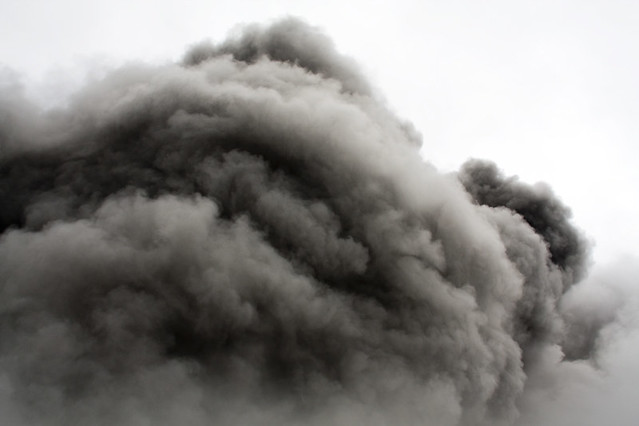
The charred, floating skull swooped down on the dragon, snapping at its back as the dragon molted from gold to red and then black. Then, as the dragon turned back to silver, it lashed out with its claws, swatting the skull against the wall of the citadel. The dragon turned to gold and summoned another stone tentacle from the ground. The tentacle lashed the head as the dragon rested in its red and black states. By the time the skull had destroyed the tentacle it was battered and cracked. It swooped down on the dragon once more, but the dragon, now silvery white once more, lashed the skull solidly with its tail. The skull shattered. At once, the ash soldiers crumbled. The dragon flew into the dome of mist, which began to dissipate with the breeze. Beatriss and Tetsukichi rose as if from a long, refreshing sleep.Dukono ash cloud

Monday, February 10, 2014

The Observatory


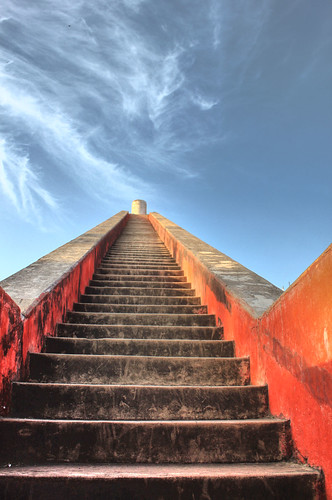
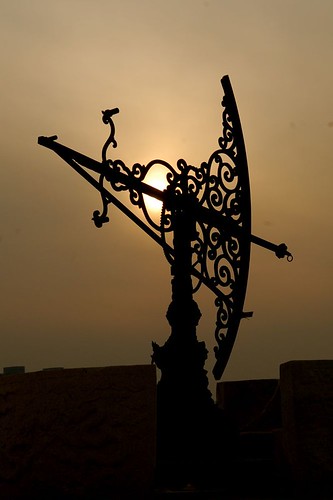
Samrat Yantra: Rear View by BibhushanBeatriss and Tetsukichi spent several weeks at an unnamed village in the cloud forest north of Tempat Larang. They found a guide who knew the way to the Observatory. Their guide, an old man, told them that when he was young, he was one of several boys who guided visiting sages to the Observatory, but as Tempat Larang fell further into ruin, the sages visited less frequently, and evil creatures began taking up residence in the Observatory. It was many years ago that he last brought a scholar there, and that young man never re-emerged. So, he was willing to guide them, but he point out the last section of the journey and then wait for them, returning to the village after one night if they did not return.

Beatriss and Tetsukichi brushed off his warnings, but prepared themselves for battle. They were accompanied by all of their retainers. Several young people from the village also accompanied the group to provide for the safety and comfort of the group.  

The hike to the Observatory took more than a full day. The night in the jungle was uneventful, except that Ju-May was plagued by terrible dreams throughout the night. In these dreams, he saw General Goyat, clutching at him with his long nails, pricking him with a rusty knife, and demanding, over and over, “Where’s Gwinch?” In fact, all the member of the party had experienced similar dreams since their meeting with the General face-to-face. Ju May spent the morning sipping tea and trying to clear his mind. Although his mind was so clouded that he could not cast spells, the party did not even consider leaving him behind during their exploration of the Observatory.

The last stage of the journey involved climbing an overgrown, but still easily discernible paved path. The Observatory itself was a solid building of stone with a domed roof. All of its windows had been bricked close, but the main entrance an open archway.

The group proceeded boldly and found themselves in a beautiful, blue-tiled, two-story entryway. Their footsteps echoed loudly, and the party made their way swiftly into one of the side rooms. They found a series of store rooms containing a variety of they termed “art supplies”—including different colors of ink, colored powders, waxes and oils, large sheets of papers, iron stamps, and a large variety of pronged bronze disks of uncertain purpose. Some of these rooms looked like they had been vandalized by other explorers.

After exploring several storerooms on the south side of the building, they sought a way to cross to the other side, looking especially for a way up. Entering a larger room, they noticed a light flickering on the other side and rushed toward it to investigate. Too late, they discovered that the floor had been oiled or waxed, and several members of the party tripped over themselves as they tried to cross the room. As they struggled to regain their feet, they were set upon by a dozen small humanoid creatures with baboon like faces and blue shaggy fur. Some of these creatures threw bronze disks at Tetsukichi, who had sprawled to the floor, while others clubbed Beatriss with iron stamps. A loan scholar would have had a hard time of it, but these two experienced warriors, supported by their most valiant companions, defended themselves handily and killed all of the nasty blue creatures, without suffering any significant wounds.

The light that first attracted their attention turned out to be a simple lamp burning in the blue creatures noisome den. A flight of stairs leading up was also hear. The party explored the upper floor of the Observatory and found the roof—a flat top to the domed roof. A strange bronze chair was there, tilted so that one sitting in it would be looking into the sky, but with a transparent “hood” that covered the sitters face. After various experiments had no unusual results, the party decided they should wait for nightfall.

sextant by Ian RileyAt nightfall, the party discovered the chair’s effects. Beatriss sat in it and was able and see her children. She saw them in fox form snowy mountainous place. Her emotions—fear, longing—seemed to interfere with her ability to watch them closely or for long. She looked for Gwinch and found him. Here her view was more clear, as she found that she could see not only Gwinch, but every step she would need to take to get to where she was, back through the jungles, swamps, and mountains where they’d traveled over the past few months, to a small building of bamboo and crumbling stone outside of Pasar. He was meditating and two men were watching him from the shadows. Tetsukichi remembered that they had a particular reason for seeking the Observatory, one related to their mission. He sat in the chair and asked to see the altar they’d read about in the library, the place they could go to summon the peoples’ protector and get assistance in undoing Goyat’s ritual. He sat in the chair, and he saw an alter in the jungle, but that’s all he saw. They asked Afu to try. Afu started to suggest that Ju- May would learn much from the experience, but everyone, even Afu could see that Ju-May was still in bad shape from his bad dreams the night before, and was nursing a nasty bite on his neck from one of the blue
creatures. So Afu sat in the chair. And after several minutes, he burst out laughing. “Yes, I can take you to the altar of Nung Chiang!”


Thursday, February 6, 2014

Another Group of Travelers Seeks a Way to Pasar


PCs
Krepu-San, Bushi (Fighter) 4
Sükh , Bushi 1
Shoji, Shukenja (cleric-ish) 3

NPCs
Jintara, Thief 3
Tetsukichi’s wife Su-Laing, their daughter Yin Yue, and their maid Kei-Lo
Beatriss’s children and their nannies Hwian and Malee
a few other, unnamed non-combatants


Meanwhile . . . back in Menkan, things were getting harder and harder for the Sansar clan. From the North and West, the lizard folk were growing in numbers and making increasingly bold attacks. And from Menkan, larger and larger contingents of Imperial forces were making increasingly frequent and increasingly intrusive “inquiries” as to the whereabouts of Tetsukichi. What he had learned about Goyat? What had he learned about Kawabi? What had he learned about Gwinch? Had he followed those other traitors?

The leaders of the clan decided that their future lay to the west. If they were called traitors, let them be traitors, and give their allegiances to a Great Khan who offered them better protection. They would fight their way through the lizard folk and never turn back.

But Su-Laing refused to go. Tetsukichi knew where to look for her here. If she went west, she and their child would never see him again. Likewise, Beatriss’s servants (Hwian and Malee) feared the consequence of separating Beatriss’s children from their mother. If the clan was going west, the families of Beatriss and Tetsukichi would find their own way to Pasar.

Costa Rica stream by Brayo
Three brave adventurers volunteered to lead the way: Sükh , a young warrior of the clan, plus Shoji, the Shaman, and Kreppu-San, a foreigner and friend to Beatriss and Tetsukichi from their days in Zipang.

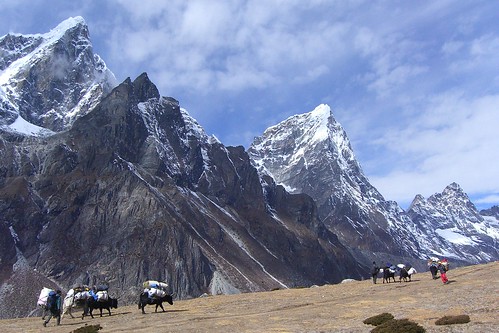
The group set off to the southwest, following the course of a river that led to a legendary “lost valley” and more practical to their immediate purposes, a road to Pasar. They traveled light, and with a spare horse for each rider, and made good time. As they traveled further from the Sansar grazing grounds, they began to find signs of the llizardfolks’ prescence—tracks, totems, and the remains of a campfire, strewn with gnawed bones, likely human. The adventurers left the non-combatants here, and made a trip into the jungle, following lizardfolk tracks. As they climbed in altitude, the air thickened with mist, and their visibility became very poor. Fearing an ambush, they started back down to the river. On their way down, they heard the noise of something following them. The heroes moved faster, with Jintara springing ahead to warn the others. Back down at the river, they took up a defensive position, and waited. Horrible undead creatures loped into view, gnashing their teeth, and dragging their long-mailed fingers across exposed stones. Kreppu-san and Sukh shot them with arrows, and Shoji transfixed them with magical light.

Emerging from this battle unscathed, the party took a second trip up the trail, and took a little more to explore the area. It was a place for disposal of the dead. Decaying lizard folk bodies, in a posture of peaceful repose, many with weapons at their side, were laid out on the ground, surrounded by stones. Also decorating the resting places of several lizard folk warriors were stakes topped with human heads and skulls. At the center of all of this was a small hut.

The party charged the hut with their weapons ready. A screamed pierced the air as they made their approach, emanating from the hut. Without hesitating, Krepu-San, shouldered through the flimsy door, and the party fell upon the hut’s occupant, a Lizard folk shaman. They killed her and then ransacked her hut, to find several pieces of amber and a holy scroll.

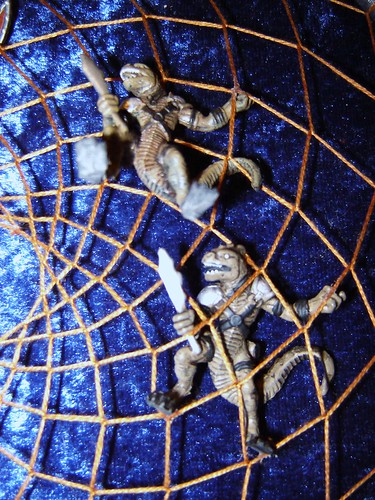
D & D Figurines 003 by ShadowWolf13
D & D Figurines 003, a photo by ShadowWolf13 on Flickr.
The adventurers returned to the river and their charges, and continued their journey. That night their sleep was interrupted by the sounds of drumming carried over many miles. They broke camp early and breakfasted on horseback, urging their mounts to travel as fast as was safely possible on the uneven ground. Krepu-San observed that not only were they being pursued by a large enemy force, it was likely that they would run into an ambush if they did not exercise caution. Reaching a place where the ground became much steeper, with ravine walls rising on either side, and boulders strewn along their path, Krepu-San insisted that they should proceed with extreme caution. He and Jintara found a place where they could climb up the walls of the ravine and see what lay before them. Reaching a look-out point perhaps two hundred feet above the trail along the river, Krepu-san looked downstream and see faintly the mass of the pursuing forces. And, sure enough, not more than 50 yards upstream, he counted a dozen lizardfolk warriors prepared for ambush. He sent Jintara back down to tell the other party what lay ahead and to prepare to assist. Then he found a hidden place from which to shoot the ambushers with his bows. Soon two of the lizardfolk warriors were on the ground, pulling arrows out of their chests. The rest of the ambushers, not seeing that the arrows had come from above, charged down the trail. The party was ready to meet them. Shoji used his magic to transfix them while Shuk drew his sword. Meanwhile Krepu-San identified and killed the leader of the ambush force. Not until most of their force were killed did the ambushers realize they were being attacked from above. By then it was then it was too late for them. Both Shuk and Krepu-san were wounded, but once their enemies were destroyed, Shoji healed them both, and the party pressed on.

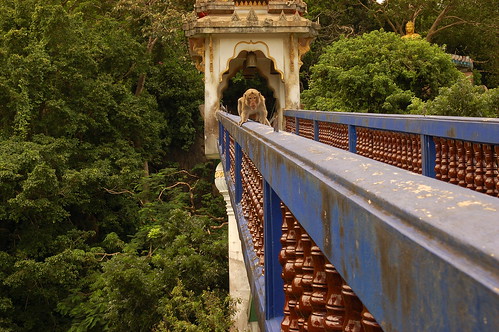
After several more hourse, the party reached a pool at the bottom of a waterfall. Their most likely way forward lay through a large archway in the wall of stone. As the sounds of the drumming and the main force of the lizardfolk drew nearer, the party saw the archway was their only option for safety. Jintata and Krepu-san confirmed that the way was wide enough for them to enter with their horses. The party entered, and climbed a ramp carved into the stone, that spiraled a few hundred feet before emerging at the top of the waterfall. A bridge crossed the river above the waterfall and in the middle of the bridge was a small tower.

As the party got closer to the tower, they found the crushed bodies of three Lizard Folk warriors. In the valley below, the advance army of the Lizard Folk were gathering by the pool and pointing at the party on the bridge. But none entered the archway.

Krepu-San and Jintara got closer to the tower and opened the door. Inside there were two statues, made of gleaming metal, and in the shape of human-like creatures with canine heads. It was a single room, with a door on the opposite side, and littered with bones and rusted armor fragments.

Jintara saw something she wanted among the bones and debris that littered the floor of the tower: a slim piece of wood, about a foot long, dyed a rich red color and banded with a golden metal. She grabbed for it, and as she did, one of the steel statues swung at her with both fists. Jintara grabbed her prize and Krepu-san pulled her out of the tower. The statue chased them. Cheers came up from the Lizard Folk in the valley. Sukh shot the statue with an arrow—and the metal was absorbed. Krepu-San and Jintara were faster than the statue, but there was nowhere to run. Jintara threw the wand. The statue kept coming.

So Krepu-San and Jintara stopped and ran toward the statue—and tried to slide past it. Krepu-San took a glancing blow, but kept running—they both reached the tower. The statue turned and came after them. They entered the tower and—as they expected, had to dodge the blows of the second statue as they opened the door and ran for the safety of the far side of the bridge. The rest of the party likewise made a mad dash across the bridge, the hardier members of the party on foot, and seeking to distract the statues, while the non-combatants rode by on horses. One of the spare horses was struck down and left on the bridge. More tragically, Su-Laing’s faithful maid Kei-Lo was struck with such force that she flew off her horse and over the side of the bridge. The party did not linger to see where she landed. Only after they reached the road on the far side of the bridge and had run for some distance did they turn to see that the statues were not following them.

Sunday, January 19, 2014

Review/Play Report of "The Tower" by James Raggi IV, published 2009

If Mr. Chick were to reprise his well-loved Dark Dungeons adventure tract for a new generation of gamers, he’d do well this time to employ the services who both understands the game and can put forward a clear, strongly worded message about the dangers of fantasy role-playing: “The souls (or spirits) of those killed by her, because they were doomed by greed (the want of an underserved kingdom) or lust (the hand of a woman they have never met) are delivered to some foul god to be tortured for eternity.”

And what is it exactly that D&D players and their characters do that leads to their doom?
“The Tower,” by James Raggi IV lays it out, with the first two levels of the adventure devoted entirely to helping PCs understand what's expected of them; four talking statues, followed by an elaborate frieze in bas-relief break down the "courtship ritual" as follows

 
  • Put aside your workaday pretenses and defenses.  (Take off your armor and put it in a box.
  • Assume the persona of someone unlike yourself.  (Put on the ritual robes and proceed up the tower.
  • Revel in collaborative story-telling with like-minded nerds. (Open the magic box and meet your prom date. )
 
Spoiler alert . . .
 

Many have opened this box.  You won't find her here either.


Something is lost. RPG players have some things in common with the readers of a novel or the audience of a play. But RPG players also expect to be full participants and to have significant influence on how the game progresses and on its outcome. From this standpoint, the big problem with this adventure is that the only way to “win” is not to play it all. (Again, Mr. Chick would be proud.)

Before I ran this adventure with PCs, I had the thought this was the kind of adventure that’s intended to be read rather than played. But in fact my players did seem to very much enjoy it. There was much debate over whether to follow the step-by-step instructions for meeting the entrapped princess. McDowell and Thundar did suspect some kind of trap, but Fezziweg the Cleric overcame them, arguing that the bas-relief depictions of a courting ceremony should be understood metaphorically. By setting asides one’s material possessions, and putting on the tattered robes of humility, he argued, those who completed the ritual would be in some way enlightened. The others were in time convinced. None expected to be awarded a kingdom they did not “deserve.” Nor did they express their “lust” for the “hand” of a woman who had not yet introduced them to her parents. They weren’t necessarily expecting wisdom and enlightenment either, but instead came around to the idea that if they went along with it, something cool would happen.

It was more me as the DM than the other players who felt keenly disappointed and ripped-off when the sarcophagus turned out to contain—surprise!— the obligatory wight (ahem, “undead thing” with an at once overdone and callously-written backstory) that haunts so many low-level adventures. The (enlightened?) players very wisely ran for their lives. Two characters (Thundar the fighter and Deah the elf warrior) was killed by the undead thing's chilling touch, while Fezziweg got sent back two levels. (Somewhat appropriately as his order is a very orthodox one, with little tolerance for the esoteric belief systems he had espoused in convincing others to open the box.) Fernac the card-sharp had a scroll of protection from undead enabling his companions to retrieve their weapons and do a little more searching of the pile of bones.

The party regrouped outside and made a last foray into the attic of the tower, expending a choice magic item to confirm that the treasure wasn’t hidden up there either. Fezziweg knew they’d made a big mistake, but wasn’t sure how: “Did we believe too much or not enough?” Was it wrong to leave their NPC associates at the bottom of the tower to guard their armor? Would the ritual had worked differently if they had gone “all in,” without a contingency plan? Or should one of their number have gone in alone, foregoing the protection of numbers? At this point I felt like the joke had gone on for enough. There was no treasure, I told them, there was nothing that they had missed, the only point of the adventure was to sucker them in and kill them and they’d done well to only lose two PCs.

I mentioned to White Bear that I was writing this review and she said: “If you are trying to encourage new players to try D&D, avoid this one. It feels depressing and unsatisfying like some kind of low-calorie bagel.”

In fact, there was one relatively new player for this session and he said he enjoyed it. My sense is that he enjoyed it as a kind of magician’s trick and has expressed his amazement that I was able to convince them to take off their armor and open a sarcophagus. In fact, I don’t remember doing any convincing at all, beyond reading the descriptions. It says a lot about the module’s imaginative power that the PCs were so captivated by its narrative. There are an abundance of interesting details (e.g. thornless roses) and the details contribute to Raggi’s intended themes (e.g. thornless roses get picked). The next step for Raggi or others who share his interests in writing convention-breaking D&D adventures is to relinquish some control over plot and even theme in combining fully-imagined scenarios with a greater possible range of player motivations and outcomes.

Friday, January 17, 2014

Hommelet: Introducing Phoebe, Philomena, and (briefly) Philch

After a recent cock-up involving a heart-shaped key, a tattered map, and an unrewarding tower, Fernac was preparing to leave Hommelet, when a new group of naïve fortune-seekers arrived. One of the newcomers, Philomena, was a natural-mage—the people of Hommelet surmised that she had as good a chance as any other young woman of convincing Burne to take her on as his apprentice. The other two—Phoebe and Philch—were not, as it turned out, Philomena’s sister and brother, but just her friends: “Our parents had adjoining farms—back in Philidge.”

Fernac explained to the three newcomers that a traveling prophet named Gerilynn had several months ago led an expedition to the ruins of an old moathouse a few leagues away and, unlike several previous expeditions, had driven out the resident evil who lived there. “Now it’s for us to glide in and sweep up the cult’s treasure before someone else jacks it.” Fernac convinced Gerilynn that another successful expedition would further improve the stature of her nascent sect. She agreed. And Bucko, a local farm hand with a keen in
terest in Gerilynn and perhaps her Faith asked to join the group.

The party followed the well-known path from Hommelet to the Moathouse. Before crossing the pile of rubble that led across the muddy moat and into the courtyard Gerilynn warned the others that giant frogs lived in the moat and vaguely remembered that she, Cinderblock and Gruber had discovered another exit, but couldn’t remember how to find it. The party circled and noticed a breach in the rear of the moathouse itself. The moat itself looked deep but there were a sufficient number of stepping stones that they decided to cross there.

Still concerned about the frogs as well as anything that might be lurking inside, Gerilynn summoned a cloak of silence over herself and her companions. One at a time, they crossed noiselessly over the stones and into the gloom of the moathouse. After passing through two large, ruined galleries, the party came upon a dark hole. Philch argued that the lower hanging fruit had already been picked, and convinced the others that they should tie a rope and climb into the hole to see what lay below.
Gerilynn shared the maps that her literate friend Cinderblock had drawn and these further convinced the party, that greater rewards required greater risks. Philch led the way and Philomena phollowed. (Sorry.)

At the bottom of the hole, they found a stinking mess and, in kicking it around, a nest of giant centipedes. The party repelled the beasties with their daggers and torches, but not before one or two had crawled into Philch’s boot stinging him on the foot and leg. The pain was enough that they nearly called off the expedition and returned to Hommelet immediately, but Gerilynn tried a healing poultice that neutralized or numbed the poison enough that Philch thought he could carry on. Exploring a little more cautiously, the party found two storerooms filled with weapons, armor, and a cask of decent brandy. Pressing on, the party discovered a torture chamber, jail cells, and several more empty galleries. Through careful study of Gerilynn’s map and tapping on the walls, Philch discovered a large block that could be pushed aside, permitting egress to a secret passage, and then a staircase spiraling down at least 50 feet.

The party descended eagerly, certain that they had discovered something previous explorers had overlooked. At the bottom they found a solid, heavy, and locked door. Philch, who had reluctantly passed on the set of unaffordable lockpicks offered him by Hommelet’s traders, started to pry the door open with his crowbar. When the oak splintered, a rush of wind plunged the party into darkness. Phoebe was good with tinder and phlint and before anyone could panic, she soon had a new torch burning.

Philch managed to get the door opened completely. Behind it there as a small alcove and another door—this one much less solid-looking, and with a ring in the center. Gerilynn pulled the ring to open it. The door didn’t open. Instead there was loud grating sound coming from above. Philomena pulled Gerilynn out of the alcove. The party watch. Indeed, a ceiling block was falling into the alcove, but its descent was much hindered by friction. The danger of being instantly crushed seemed less likely and thus less weighty than the risk of losing their opportunity to get beyond this second door. Phoebe ran in and put her shoulder to it and found that it opened outwards. Furthermore, opening it, seemed to halt the fall of the ceiling block.

The party passed through a rough-hewn passage—much different than anything seen above in the dungeons of the moathouse, and stepped into a large cavern. Here, two shaggy white creatures bearing enormous swords rushed to attack them. Philch flung a spear and then charged with his sword. He was joined by Gerilynn, Bucko, and Phobe while Philomena hid herself in a dark corner and Fernac guarded the retreat route. Fearsome, but lacking finesse, the monsters were stabbed again and again while their own heavy blades clanged against the cavern walls. Philomena circled for a surprise attack, but her dagger got entangled in the monsters matted fur without reaching its body. The monster turned on her and Philch charged to her defense. He was hit by two solid blows and crumpled to the ground. Here Fernac loosed two arrows in quick succession to kill this monster while Phoebe slew the other with her war hammer. Philch was alive, but badly wounded. Bucko, too, had sustained serious wounds. Gerilynn ministered to them, and helped them regain their feet and their breath, but it was obvious to all that they must return to daylight and civilization.

As the party reached the top of the spiral staircase, the party heard footsteps and voices. The party stopped and listened. Nothing. After waiting a few minutes, breath hushed and weapons ready, the party continued to the top of the stairs. They passed through empty galleries and reached the storeroom where Philch had been bit by centipedes. Philch and Bucko did not have the strength to climb out of the hole under their own power and so the party created harnesses to hoist them out.

The party moved quickly through the ground level of the moathouse to the breach and the stepping stones to cross the moat . . .

Sadly, Philch fell in and the splash attracted the frogs attention. Fernac shot arrows at the bulbous eyes breaking the surface, but Philch only came up for an instant before being sucked under for good. Another frog broke the surface just long enough to shoot a long sticky tongue and grab Bucko as he teetered on the bank. The rest of the party made it across safely and trudged back to Hommelet in silence.
a cloak hangs on a peg at the bottom of some stairs leading up by Brayo